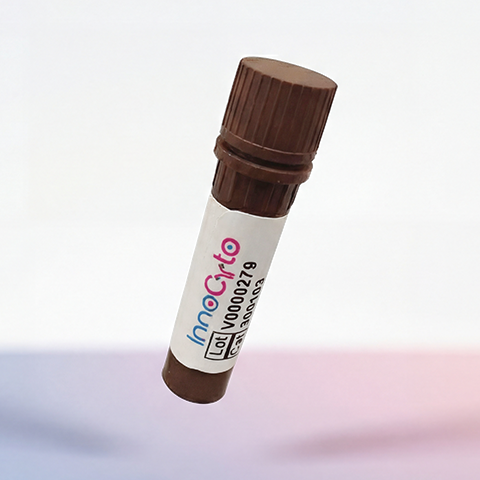
| Cat # | Size | Price | Quantity | |
|---|---|---|---|---|
| 501501 | 1 mg | $250 | ||
| 501502 | 5 mg | $750 | ||
| 501503 | 20 mg | $2000 |
| Clone | Clenoliximab |
|---|---|
| Application | Flow cytometry, animal model study |
| Host Species | Mammalian cells |
| Reactivity | Human |
| Format | Liquid |
| Product Description | Anti-Human CD4 (Clenoliximab Biosimilar) |
| Isotype | Human IgG4 |
| Regulatory Status | RUO |
| Clonality | Recombinant |
| Immunogen | Human CD4 |
| Species specificity | Human |
| Purity | >95% by reducing SDS-PAGE |
| Grade | In vivo |
| Storage Conditions | 4ºC |
| Maximal Shelf Life | 12 months |
| Target Name | CD4, T4, Leu3a |
| Antibody Type | Recombinant |
| Research Areas | T cells, T cell Activation, Adaptive Immunity |
| See All Formats | Clone Clenoliximab |
Clenoliximab is a chimeric monoclonal antibody designed to bind specifically to human CD4, a glycoprotein expressed on the surface of T-helper lymphocytes, monocytes, macrophages, and dendritic cells. Structurally, Clenoliximab belongs to the immunoglobulin G1 (IgG1) subclass and has a molecular weight of approximately 150 kilodaltons (kDa). The antibody is composed of two identical heavy chains and two identical light chains connected by interchain disulfide bonds, forming the classical Y-shaped configuration characteristic of immunoglobulins. Each heavy chain contains one variable (VH) domain and three constant (CH1-CH3) domains, whereas each light chain contains one variable (VL) and one constant (CL) domain. The molecule is produced through recombinant DNA technology in mammalian expression systems to ensure proper glycosylation and folding.
The antigen-binding domains of Clenoliximab, contained within its complementarity-determining regions (CDRs), are derived from murine sequences, while the constant regions are of human origin—hence its classification as a chimeric antibody. The murine-derived variable regions confer antigen specificity, enabling high-affinity recognition of the D1 domain of the CD4 receptor. Upon binding, Clenoliximab sterically hinders the interaction between CD4 and major histocompatibility complex class II (MHC-II) molecules on antigen-presenting cells. This blockade modulates receptor-associated signaling processes and alters downstream intracellular activation cascades involving protein kinases and transcription factors such as NF-AT and NF-κB, which govern cytokine production and T-cell proliferation in experimental systems.
The Fc (fragment crystallizable) region of Clenoliximab contributes to molecular stability and prolonged half-life through interaction with neonatal Fc receptors (FcRn). As an IgG1 molecule, it also retains the potential for effector functions, including limited engagement with Fc gamma receptors (FcγRs) and complement components in immune assays. Overall, Clenoliximab illustrates a rationally engineered chimeric IgG1 antibody that combines murine antigen recognition with human structural domains to precisely target and modulate CD4-mediated immune interactions in mechanistic immunological research.
Anti-Human CD4 (Clenoliximab Biosimilar) TDS
Anti-Human CD3 Antibody, Clone Hit3a
iF700 Anti-Human CD3 Antibody, Clone Hit3a
iF488 Anti-Human CD3 Antibody, Clone OKT3
PerCP/Cyanine5.5 Anti-Human CD3 Antibody, Clone OKT3
Biotin Human CD4 Protein (C-His-Avi)
Anti-Human CD4 Antibody, Clone 004AB
iF488 Anti-Human CD4 Antibody, Clone OKT4-Rec
iF647 Anti-Human CD4 Antibody, Clone OKT4-Rec
Have a product or application question? Consult our FAQs or contact us.