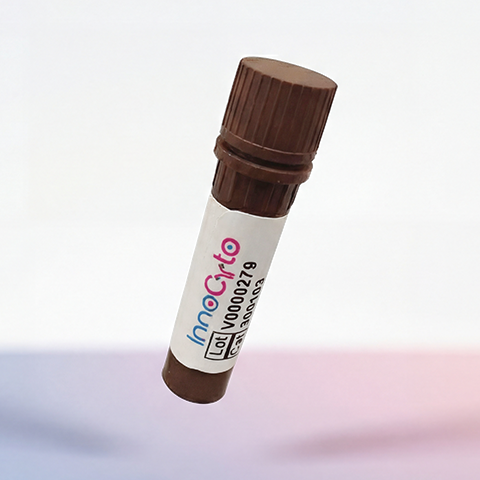
| Cat # | Size | Price | Quantity | |
|---|---|---|---|---|
| 502801 | 1 mg | $190 | ||
| 502802 | 5 mg | $750 | ||
| 502803 | 20 mg | $1800 |
| Clone | Evolocumab |
|---|---|
| Application | Flow cytometry, animal model study |
| Host Species | Mammalian cells |
| Reactivity | Human |
| Format | Liquid |
| Product Description | Anti-Human PCSK9 (Evolocumab Biosimilar) |
| Isotype | Human IgG2 |
| Regulatory Status | RUO |
| Clonality | Recombinant |
| Immunogen | Human PCSK9 |
| Species specificity | Human |
| Purity | >95% by reducing SDS-PAGE |
| Grade | In vivo |
| Storage Conditions | 4ºC |
| Maximal Shelf Life | 12 months |
| RRID | AB_3739304 |
| Target Name | PCSK9, Neural Apoptosis Regulated Convertase 1 (NARC1) |
| Antibody Type | Recombinant |
| Research Areas | Metabolism, Cholesterol |
| See All Formats | Clone Evolocumab |
Evolocumab is a fully human monoclonal antibody belonging to the immunoglobulin G2 (IgG2) subclass, engineered to bind with high specificity and affinity to proprotein convertase subtilisin/kexin type 9 (PCSK9). Structurally, it is a glycoprotein with a molecular weight of approximately 144 kilodaltons (kDa). Evolocumab is composed of two identical heavy chains and two identical light chains connected by disulfide bonds, forming the canonical Y-shaped structure typical of antibodies. It is expressed in mammalian cell systems, such as Chinese Hamster Ovary (CHO) cells, which facilitate proper folding, disulfide linkages, and glycosylation for stability and bioactivity.
The variable domains of Evolocumab’s heavy (VH) and light (VL) chains contain complementarity-determining regions (CDRs) that create an antigen-binding site capable of specifically recognizing PCSK9. This serine protease circulates in plasma and plays a central role in lipid metabolism by regulating the degradation of low-density lipoprotein receptors (LDLR) on hepatocyte membranes. Evolocumab binds PCSK9 with sub-nanomolar affinity through non-covalent interactions such as hydrogen bonding, electrostatic attraction, and hydrophobic contacts. By occupying its active binding interface, Evolocumab prevents PCSK9 from associating with LDLR, thereby inhibiting receptor internalization and degradation. This molecular blockade preserves LDLR availability on cell surfaces, enhancing receptor recycling and sustaining receptor-mediated endocytosis processes in biochemical systems.
The Fc (fragment crystallizable) portion of Evolocumab, derived from human IgG2, contributes to its structural integrity and extended serum half-life via interaction with the neonatal Fc receptor (FcRn), which recycles the antibody and protects it from lysosomal degradation. The IgG2 backbone is selected to minimize effector functions, reducing complement activation and antibody-dependent cellular cytotoxicity (ADCC).
Anti-Human PCSK9 (Evolocumab Biosimilar) TDS
Have a product or application question? Consult our FAQs or contact us.