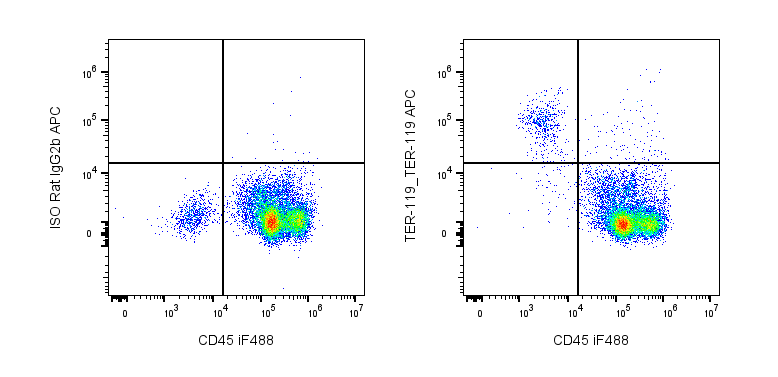
| Cat # | Size | Price | Quantity | |
|---|---|---|---|---|
| 202902 | 25 tests | $85 | ||
| 202903 | 100 tests | $180 |
| Clone | Ter-119 |
|---|---|
| Application | Flow Cytometry |
| Reactivity | Mouse |
| Format | APC |
| Target Name | Ter119, Ly-76 |
| Isotype | Rat IgG2b |
| Antibody Type | Monoclonal |
| Regulatory Status | RUO |
| Formulation | Phosphate-buffered solution, pH 7.2, containing 0.09% sodium azide and 0.2% (w/v) BSA |
| Protein Concentration | Supplied at a lot-specific concentration. |
| Storage&Handling | The antibody solution should be stored undiluted between 2°C and 8°C, and protected from prolonged exposure to light. Do not freeze. |
| Recommended Usage | For flow cytometric staining, it is recommended to use 5 µL of this reagent per 0.5-1.0 million cells in a 100 µL volume. Optimal reagent performance should be determined by titration for each specific application. APC has an excitation max at 650 nm and an emission max at 660 nm. |
| Excitation Laser | Red Laser (633 nm) |
| Research Areas | Red blood cells |
| See All Formats | Clone Ter-119 |
TER-119 is a well-known erythroid-specific cell surface antigen used as a marker of erythroid cell development in mice. It is primarily recognized by the monoclonal antibody TER-119, which identifies a distinct epitope present on glycophorin A-associated membrane glycoproteins of erythroid lineage cells. The TER-119 antigen is expressed from the proerythroblast stage through mature erythrocytes, making it a valuable tool for studying erythropoiesis, the process of red blood cell formation.
Structurally, TER-119 is not a single protein but an epitope located on a component of a larger membrane protein complex within the erythroid cell membrane. The exact molecular identity of the TER-119 antigen was elucidated as part of the Band 3 complex, which includes proteins like glycophorin A and other membrane skeleton-binding components. This association links the TER-119 epitope to structures involved in maintaining erythrocyte membrane integrity and stability. Because TER-119 recognizes a conformational determinant dependent on interactions among membrane proteins, it is widely used in flow cytometry and immunohistochemical analysis to label and quantify maturing red blood cells in murine systems.
Though no traditional ligands bind to TER-119 in a signaling capacity, its molecular association with membrane glycoproteins and cytoskeletal linker proteins suggests a role in structural organization and cell membrane maintenance. Functionally, the protein complex containing the TER-119 antigen contributes to mechanical flexibility and ion transport in erythrocytes, critical for the survival of these cells in circulation.
While TER-119 itself is not directly implicated in disease, its use in experimental models has provided insights into hematologic disorders such as anemia, hemolytic diseases, and bone marrow failure syndromes. TER-119 staining enables researchers to distinguish between stages of erythroid maturation, allowing precise assessment of defects in red blood cell development. In research and preclinical settings, TER-119 serves as an essential diagnostic and monitoring tool for therapeutic interventions that target erythropoiesis, including erythropoietin (EPO) therapy and emerging treatments that modulate red cell production or survival. Thus, although the TER-119 antigen is not a therapeutic target per se, it remains a cornerstone marker in studying erythroid biology and related pathologies.
APC Rat IgG2b Isotype Control Antibody
APC Anti-Mouse Ter119 Antibody TDS
Anti-mouse CD117 (c-Kit) Antibody, Clone 2B8
iF647 Anti-mouse CD117 (c-Kit) Antibody, Clone 2B8
Have a product or application question? Consult our FAQs or contact us.