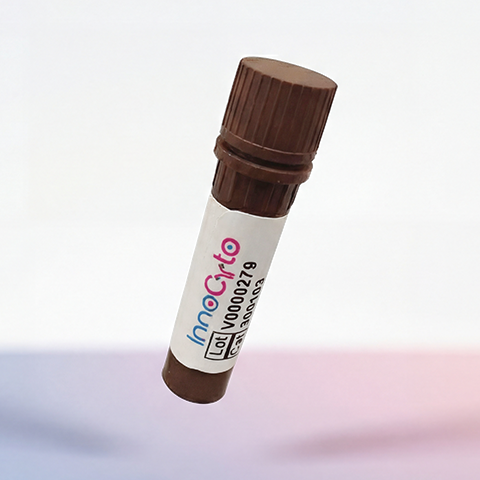
| Cat # | Size | Price | Quantity | |
|---|---|---|---|---|
| 604207 | 25 ug | $145 | ||
| 604208 | 100 ug | $325 |
| Application | Flow Cytometry |
|---|---|
| Format | Liquid, APC |
| Expression Host | E.coli |
| Target Name | Annexin A5 |
| Species | Human |
| Accession Number | P08758 |
| Sources | Recombinant Human Annexin A5 (Met1-Asp320) with N-His-Xa tag is expressed in E.coli system. His tag is cut by Xa after purification. This protein is then conjugated to APC. |
| Molecular Weight | This protein has a predicted molecular weight of 35.9 kDa. Under DTT-reducing conditions, the protein migrates at approximately 35 kDa on SDS-PAGE prior to conjugation. |
| Affinity Tag | None |
| Regulatory Status | RUO |
| Formulation | 1xPBS buffer, pH7.4, 0.09% NaN3 with a carrier protein |
| Endotoxin level | Not tested |
| Protein Concentration | 25µg size is bottled at 0.1mg/mL concentration. 100 µg size is bottled at lot specific concentration. |
| Storage and Handling | Briefly centrifuge the vial upon receipt. An unopened vial may be stored at 2–8°C for up to six months. |
Annexin V is a calcium-dependent phospholipid-binding protein widely used as a tool to detect apoptosis. It belongs to the annexin family of proteins, which share the ability to bind negatively charged membrane phospholipids in the presence of calcium ions. Annexin V has high affinity for phosphatidylserine (PS), a phospholipid that is normally confined to the inner leaflet of the plasma membrane in healthy cells. During early apoptosis, PS becomes externalized to the outer leaflet, where Annexin V can bind, making it a sensitive marker for programmed cell death.
Structurally, Annexin V is a ~35–36 kDa protein composed of four homologous annexin repeats that form a slightly curved, disc-like structure. Each repeat contributes to calcium-binding sites that coordinate calcium ions, enabling the protein to interact with phospholipid head groups. The convex surface of Annexin V mediates membrane binding in a calcium-dependent manner, while the opposite surface remains exposed for detection when conjugated to fluorophores or other labels. Annexin V can also form two-dimensional arrays on membrane surfaces under certain conditions.
Its primary ligands are phosphatidylserine and calcium ions. In research and development, fluorescently labeled Annexin V (e.g., FITC, PE, or APC conjugates) is extensively used in flow cytometry and fluorescence microscopy to quantify apoptotic cells. It is commonly combined with viability dyes such as propidium iodide to distinguish early apoptotic, late apoptotic, and necrotic cells. Beyond apoptosis assays, Annexin V is used in drug screening, cancer biology, immunology, and toxicology studies. Its reliable and specific detection of PS exposure makes it a foundational reagent in cell death analysis and therapeutic development workflows.
APC Human Annexin V Protein TDS
Biotin Human Annexin V Protein
Have a product or application question? Consult our FAQs or contact us.