| Cat # | Size | Price | Quantity | |
|---|---|---|---|---|
| 606603 | 25 ug | $245 | ||
| 606604 | 100 ug | $595 |
| Application | ELISA, BLI |
|---|---|
| Format | Liquid, Biotinylated |
| Expression Host | CHO |
| Target Name | TNFSF18, GITR Ligand, AITRL, TL6, GITRL |
| Species | Human |
| Accession Number | Q9UNG2 |
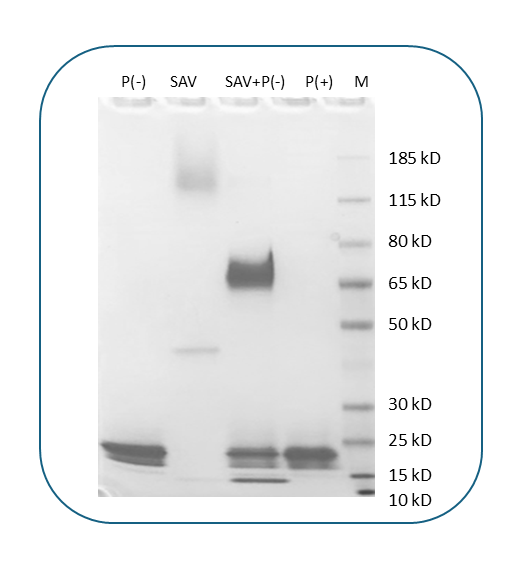
| Sources | Recombinant Human TNFSF18 (Glu52-Ser177) with N-terminus His-Avi tag is expressed in CHO cells. This protein was site-specifically labeled with Biotin by BirA ligase. |
| Molecular Weight | This prtoein has the predicted molecular weight of 18.3 kD. Under DTT-reducing conditions, the protein migrates at approximately 20 kD on SDS-PAGE |
| Affinity Tag | N-His-Avi |
| Purity | >95% based on SDS-PAGE under reducing condition |
| Regulatory Status | RUO |
| Formulation | 1xPBS buffer, pH7.4, 0.22 µm filtered |
| Endotoxin level | Less than 0.1 EU/µg protein as determined by the LAL method |
| Protein Concentration | 25µg size is bottled at 0.2mg/mL concentration. 100 µg size is supplied at a lot-specific concentration. |
| Storage and Handling | Briefly centrifuge the vial upon receipt. An unopened vial can be stored at 4°C for up to 2 weeks, or at -20°C or below for up to six months. The protein may be further diluted to 0.1 mg/mL using 0.22 µm-filtered PBS buffer (pH 7.4). For long-term storage, the diluted stock solution should be aliquoted and stored at ≤ –70°C to minimize freeze-thaw cycles. If additional dilution is required, carrier proteins such as FBS or BSA should be added to maintain protein stability. |
| Recommended Usage | For detection, use a secondary reagent with this product. |
| Research Areas | Dendritic cells, Macrophages, B cells, Tfh cells, Endothelial cells, Cancer Marker, Co-stimulation, Immune Checkpoints |
Glucocorticoid-Induced TNF Receptor Ligand (GITRL), also known as TNFSF18, is a member of the tumor necrosis factor (TNF) ligand superfamily. It functions as the cognate ligand for GITR (Glucocorticoid-Induced TNFR-Related protein, or TNFRSF18), an immunoregulatory receptor expressed primarily on activated T cells, regulatory T cells (Tregs), and natural killer (NK) cells. The GITR–GITRL interaction plays a key role in modulating immune responses, particularly in balancing immune activation and tolerance. Engagement of GITR by GITRL activates costimulatory signaling that enhances T cell proliferation, survival, and cytokine production, while weakening Treg-mediated suppression, thereby amplifying immune responses under certain conditions.
Structurally, GITRL is a type II transmembrane protein consisting of a short N-terminal cytoplasmic domain, a transmembrane domain, and a C-terminal extracellular domain responsible for receptor binding. The extracellular region adopts a characteristic TNF homotrimeric structure, composed of three GITRL monomers forming a bell-shaped complex that interacts symmetrically with three GITR receptor subunits. This trimeric configuration is essential for effective receptor clustering and downstream signal transduction. In some species, including humans, soluble forms of GITRL also exist and can modulate signaling in a concentration-dependent manner, though their physiological roles remain less fully understood.
Functionally, GITRL acts primarily as a costimulatory molecule that modulates both innate and adaptive immunity. It is expressed on antigen-presenting cells such as dendritic cells, macrophages, and B cells, as well as on endothelial cells following inflammatory stimuli. Its main receptor, GITR, signals through TRAF family adaptor proteins to activate NF-κB and MAPK pathways, leading to T cell activation and cytokine secretion. Through these effects, GITRL contributes to immune regulation but may also exacerbate inflammation or autoimmunity if dysregulated.
In disease contexts, aberrant GITR–GITRL signaling has been linked to autoimmunity, chronic inflammation, and cancer. Overactivation of this pathway can promote effector T cell activity and reduce Treg-mediated tolerance, contributing to autoimmune conditions such as rheumatoid arthritis and lupus. Conversely, in cancer, GITRL engagement enhances anti-tumor immunity by revitalizing T cells in the tumor microenvironment. Consequently, GITR agonists and GITRL-based therapies are being explored in immuno-oncology to potentiate immune responses against tumors, while GITR pathway inhibitors might offer therapeutic benefit in autoimmune disorders.
Biotin Human GITRL/TNFSF18 Protein (N-His-Avi) TDS
Human GITRL/TNFSF18 Protein (N-His)
Human GITRL/TNFSF18 Protein (N-His-Avi)
Have a product or application question? Consult our FAQs or contact us.