| Cat # | Size | Price | Quantity | |
|---|---|---|---|---|
| 605801 | 25 ug | $145 | ||
| 605802 | 100 ug | $295 |
| Application | ELISA, BLI |
|---|---|
| Format | Liquid, Purified |
| Expression Host | CHO |
| Target Name | TNFSF9, 4-1BB Ligand, CD137L |
| Species | Human |
| Accession Number | P41273 |
| Sources | Recombinant Human TNFSF15 (Leu72-Leu251) with N-terminus Fc tag is expressed in CHO cells. |
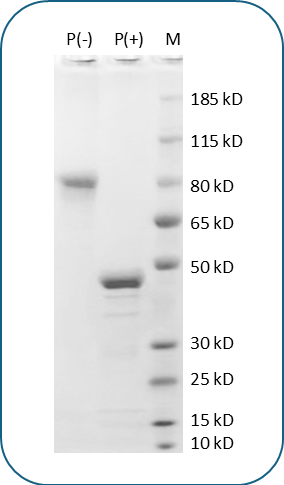
| Molecular Weight | This protein has a predicted molecular weight of 45.4 kDa. Under DTT-reducing conditions, the protein migrates at approximately 46 kDa on SDS-PAGE. |
| Affinity Tag | N-Fc |
| Purity | >95% based on SDS-PAGE under reducing condition |
| Regulatory Status | RUO |
| Formulation | 1xPBS buffer, pH7.4, 0.22 µm filtered |
| Endotoxin level | Not tested |
| Protein Concentration | 25µg size is bottled at 0.2mg/mL concentration. 100 µg size is supplied at a lot-specific concentration. |
| Storage and Handling | Briefly centrifuge the vial upon receipt. An unopened vial can be stored at 4°C for up to 2 weeks, or at -20°C or below for up to six months. The protein may be further diluted to 0.1 mg/mL using 0.22 µm-filtered PBS buffer (pH 7.4). For long-term storage, the diluted stock solution should be aliquoted and stored at ≤ –70°C to minimize freeze-thaw cycles. If additional dilution is required, carrier proteins such as FBS or BSA should be added to maintain protein stability. |
| Research Areas | Co-stimulation, Dendritic cells, Monocytes, Macrophages, B cells, Cancer Marker, Inflammation |
4-1BB ligand (4-1BBL), also known as CD137L and encoded by the TNFSF9 gene, is a costimulatory molecule belonging to the tumor necrosis factor (TNF) superfamily. It is primarily expressed on activated antigen-presenting cells (APCs), including dendritic cells, macrophages, and B cells, as well as on some non-hematopoietic cells under inflammatory conditions. 4-1BBL plays a central role in enhancing cellular immune responses by engaging its receptor, 4-1BB (CD137), which is expressed on activated CD8⁺ and CD4⁺ T cells, natural killer (NK) cells, and certain other immune subsets.
Structurally, 4-1BBL is a type II transmembrane protein characterized by a short N-terminal cytoplasmic region, a single transmembrane domain, and a C-terminal extracellular TNF homology domain. Like other TNF superfamily ligands, it forms homotrimers on the cell surface, a configuration necessary for efficient receptor clustering and signaling. Soluble forms of 4-1BBL have also been described, although membrane-bound trimeric forms are generally more potent in mediating biological activity.
The primary ligand for 4-1BBL is 4-1BB (CD137), a member of the TNF receptor superfamily. Engagement of 4-1BB by 4-1BBL recruits TNF receptor–associated factors (TRAFs) to the receptor cytoplasmic tail, activating NF-κB, MAPK, and PI3K–Akt signaling pathways. This signaling enhances T cell proliferation, cytokine production (notably IFN-γ), cytotoxic function, and survival, particularly in CD8⁺ T cells. 4-1BBL can also transmit “reverse signaling” into APCs, modulating their activation and cytokine profiles.
Dysregulated 4-1BB/4-1BBL signaling has implications in cancer, chronic infection, and autoimmune disease. In oncology, 4-1BB signaling supports antitumor cytotoxic T cell responses, making it an attractive immunotherapeutic target. However, excessive activation can contribute to immune-mediated tissue damage or autoimmunity.
Therapeutically, strategies targeting the 4-1BB axis are being actively developed. Agonistic antibodies to 4-1BB aim to enhance antitumor immunity, often in combination with checkpoint inhibitors. Engineered 4-1BBL constructs are also incorporated into cancer vaccines and chimeric antigen receptor (CAR) T cell designs to improve persistence and function. By amplifying cytotoxic immune responses, 4-1BBL-based approaches represent a promising avenue in cancer immunotherapy and immune modulation.
Human 4-1BBL/TNFSF9 Protein (N-Fc) TDS
Human CD137/4-1BB/TNFRSF9 Protein (C-His-Avi)
Biotin Human CD137/4-1BB/TNFRSF9 Protein (C-His-Avi)
Human CD137/4-1BB/TNFRSF9 Protein (C-His)
PE Human CD137/4-1BB/TNFRSF9 Protein (C-His)
Human 4-1BBL/TNFSF9 Protein (N-His)
Have a product or application question? Consult our FAQs or contact us.