| Cat # | Size | Price | Quantity | |
|---|---|---|---|---|
| 805201 | 25 ug | $145 | ||
| 805202 | 100 ug | $295 |
| Application | ELISA, BLI |
|---|---|
| Format | Liquid, Purified |
| Expression Host | CHO |
| Target Name | CD171, L1CAM |
| Species | Human |
| Sources | Recombinant Human CD171/L1CAM protein (Ile20-Glu1120) with C-terminus His tag is expressed in CHO cells. |
| Accession Number | P32004 |
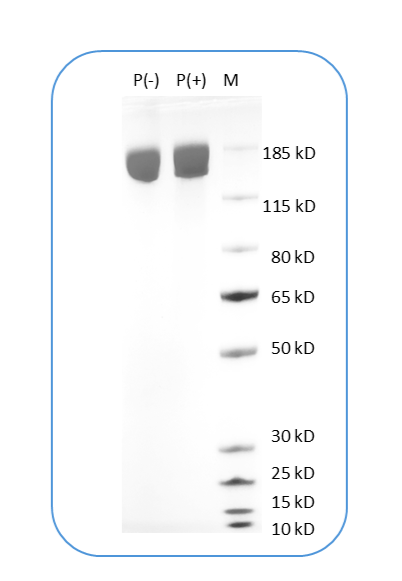
| Molecular Weight | The protein has a predicted molecular weight of 124.7 kDa. Under DTT-reducing conditions, it migrates at approximately 160-200 kDa on SDS-PAGE. |
| Affinity Tag | C-His |
| Purity | >95% based on SDS-PAGE under reducing condition |
| Regulatory Status | RUO |
| Formulation | 1xPBS buffer, pH7.4, 0.22 µm filtered |
| Endotoxin level | Not tested |
| Protein Concentration | 25µg size is bottled at 0.2mg/mL concentration. 100 µg size is supplied at a lot-specific concentration. |
| Storage and Handling | Briefly centrifuge the vial upon receipt. An unopened vial can be stored at 4°C for up to 2 weeks, or at -20°C or below for up to six months. The protein may be further diluted to 0.1 mg/mL using 0.22 µm-filtered PBS buffer (pH 7.4). For long-term storage, the diluted stock solution should be aliquoted and stored at ≤ –70°C to minimize freeze-thaw cycles. If additional dilution is required, carrier proteins such as FBS or BSA should be added to maintain protein stability. |
| Research Areas | Adhesion Molecules, Neurons, Cancer Marker |
CD171, also known as L1 cell adhesion molecule (L1CAM), is a transmembrane glycoprotein belonging to the immunoglobulin superfamily that plays crucial roles in nervous system development and function. It mediates cell-cell adhesion, neuronal migration, axon guidance, and synapse formation during embryonic development and neural plasticity in adults. L1CAM facilitates these processes through homophilic binding (L1CAM-L1CAM interactions between adjacent cells) and heterophilic interactions with various extracellular matrix proteins and cell surface receptors. Beyond the nervous system, CD171 is involved in cell motility, survival signaling, and tissue organization.
Structurally, CD171 is a type I transmembrane protein of approximately 200-220 kDa consisting of several distinct domains. The extracellular region contains six immunoglobulin-like (Ig) domains followed by five fibronectin type III repeats, which mediate protein-protein interactions. These domains enable CD171 to engage in both homophilic and heterophilic binding. The protein also has a single transmembrane domain and a highly conserved cytoplasmic tail that interacts with the actin cytoskeleton through ankyrin binding and participates in intracellular signaling pathways, including activation of kinases such as ERK and PI3K/AKT that promote cell survival and migration.
CD171 interacts with multiple ligands, including itself (homophilic binding), integrins (particularly αvβ3 and α5β1), neuropilin-1, axonin-1/TAG-1, and components of the extracellular matrix such as laminin and fibronectin. These diverse interactions enable CD171 to coordinate complex cellular behaviors including adhesion, migration, and signal transduction. The cytoplasmic domain also binds adaptor proteins like ankyrin, ezrin, and AP-2, linking membrane events to cytoskeletal reorganization.
In disease contexts, aberrant CD171 expression is implicated in various pathologies. Mutations in the L1CAM gene cause X-linked hydrocephalus and CRASH syndrome (corpus callosum hypoplasia, retardation, adducted thumbs, spasticity, and hydrocephalus), severe neurological disorders affecting brain development. In oncology, CD171 overexpression is observed in numerous cancers, including neuroblastoma, glioblastoma, ovarian, endometrial, pancreatic, and colorectal carcinomas, where it promotes tumor invasion, metastasis, and chemoresistance. Therapeutically, CD171 is being targeted through multiple approaches: monoclonal antibodies, antibody-drug conjugates, chimeric antigen receptor (CAR) T cell therapies, and small molecule inhibitors. Clinical trials are evaluating CD171-directed CAR-T cells for neuroblastoma and other pediatric solid tumors, positioning this molecule as a promising target in precision cancer immunotherapy.
Human CD171/L1CAM Protein (C-His) TDS
Human CD171/L1CAM Protein (C-His-Avi)
Biotin Human CD171/L1CAM Protein (C-His-Avi)
PE Human CD171/L1CAM Protein (C-His)
APC Human CD171/L1CAM Protein (C-His)
Have a product or application question? Consult our FAQs or contact us.