| Cat # | Size | Price | Quantity | |
|---|---|---|---|---|
| 606001 | 25 ug | $145 | ||
| 606002 | 100 ug | $295 |
| Application | ELISA, BLI |
|---|---|
| Format | Liquid, Purified |
| Expression Host | CHO |
| Target Name | Notum, Palmitoleoyl-protein carboxylesterase NOTUM |
| Species | Human |
| Accession Number | Q6P988 |
| Sources | Recombinant Human Notum (Ser20-Ser496) with C-terminus Fc tag was expressed in CHO cells. |
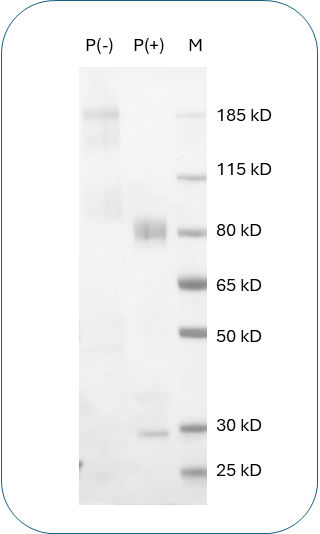
| Molecular Weight | This prtoein has the predicted molecular weight of 79.89 kD. Under DTT-reducing conditions, the protein migrates at approximately 80 kD on SDS-PAGE |
| Affinity Tag | C-Fc |
| Purity | >80% based on SDS-PAGE under reducing condition |
| Regulatory Status | RUO |
| Formulation | 1xPBS buffer, pH7.4, 0.22 µm filtered |
| Endotoxin level | Not tested |
| Protein Concentration | 25µg size is bottled at 0.2mg/mL concentration. 100 µg size is supplied at a lot-specific concentration. |
| Storage and Handling | Briefly centrifuge the vial upon receipt. An unopened vial can be stored at 4°C for up to 2 weeks, or at -20°C or below for up to six months. The protein may be further diluted to 0.1 mg/mL using 0.22 µm-filtered PBS buffer (pH 7.4). For long-term storage, the diluted stock solution should be aliquoted and stored at ≤ –70°C to minimize freeze-thaw cycles. If additional dilution is required, carrier proteins such as FBS or BSA should be added to maintain protein stability. |
| Research Areas | Cancer Marker |
Notum is a secreted carboxylesterase enzyme that functions as a key regulator of the Wnt signaling pathway, a vital system that governs embryonic development, tissue regeneration, and cellular homeostasis. Its primary role is to deactivate Wnt proteins by enzymatically removing a palmitoleate group—a lipid modification required for Wnt’s binding to its receptor, Frizzled. Through this process, Notum fine-tunes the intensity and duration of Wnt signaling, preventing excessive pathway activation that can lead to abnormal growth or differentiation.
Structurally, Notum belongs to the α/β-hydrolase fold enzyme family, characterized by a central β-sheet core flanked by α-helices. The active site includes a conserved catalytic triad typically composed of serine, histidine, and aspartate residues. These residues coordinate to mediate hydrolysis of the ester bond linking the lipid moiety to the Wnt protein. High-resolution crystal structures of Notum have revealed a hydrophobic pocket near the active site that accommodates the palmitoleate chain, and a flexible "lid" region that moves to facilitate substrate access. The enzyme also exhibits calcium-binding sites that stabilize its tertiary structure and enhance catalytic efficiency.
Notum’s ligands include both the endogenous Wnt lipids and a growing number of small-molecule inhibitors designed to target its catalytic pocket. These inhibitors often mimic the lipid substrate or covalently modify the active-site serine to block enzymatic activity. Such compounds have proven useful in experimentally manipulating Wnt activity and hold potential as drug candidates for disease modulation.
Dysregulation of Notum is implicated in several human diseases. Overactivity of Notum suppresses Wnt signaling, contributing to degenerative conditions such as osteoporosis, osteoarthritis, and neurodegeneration. Conversely, underexpression or inhibition of Notum is linked to excessive Wnt pathway activation in cancers, including colorectal, liver, and pancreatic tumors. Recent research indicates that selective Notum inhibition may restore regenerative capacity in aged tissues and stimulate bone formation, offering therapeutic promise for age-related disorders. Thus, Notum has emerged as a compelling pharmacological target: its modulation could either attenuate oncogenic signaling in tumors or enhance regenerative signaling in degenerative diseases.
Human Notum Protein (C-Fc) TDS
Cyno Monkey Notum Protein (C-His)
Have a product or application question? Consult our FAQs or contact us.