| Cat # | Size | Price | Quantity | |
|---|---|---|---|---|
| 601701 | 25 ug | $145 | ||
| 601702 | 100 ug | $295 |
| Application | ELISA, BLI |
|---|---|
| Format | Liquid, Purified |
| Expression Host | CHO |
| Target Name | SUMF1, Formylglycine-generating enzyme |
| Species | Human |
| Accession Number | Q8NBK3 |
| Sources | Recombinant human SUMF1 protein (Ser34-Asp374) with N-terminus His tag was expressed in CHO Cells. |
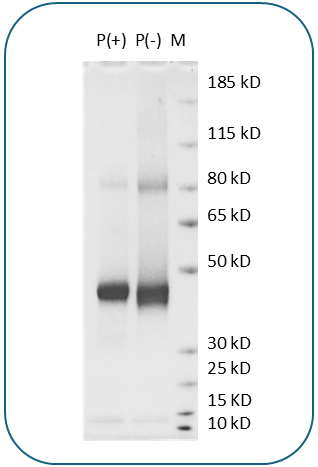
| Molecular Weight | This protein has a predicted molecular weight of 39.6 kDa. Under DTT-reducing conditions, the protein migrates at approximately 45 kDa on SDS-PAGE. |
| Affinity Tag | N-His |
| Purity | >90% based on SDS-PAGE under reducing condition |
| Regulatory Status | RUO |
| Formulation | 25 mM HEPES, 150 mM NaCl, 10% Glycerol, pH 7.4 |
| Endotoxin level | Not tested |
| Protein Concentration | 25µg size is bottled at 0.2mg/mL concentration. 100 µg size is supplied at a lot-specific concentration. |
| Storage and Handling | Briefly centrifuge the vial upon receipt. An unopened vial can be stored at 4°C for up to 2 weeks, or at -20°C or below for up to six months. The protein may be further diluted to 0.1 mg/mL using 0.22 µm-filtered HEPES buffer (pH 7.4). For long-term storage, the diluted stock solution should be aliquoted and stored at ≤ –70°C to minimize freeze-thaw cycles. If additional dilution is required, carrier proteins such as FBS or BSA should be added to maintain protein stability. |
| Research Areas | Metabolism |
Sulfatase-modifying factor 1 (SUMF1) is an essential endoplasmic reticulum (ER)–resident enzyme that functions as the master activator of all cellular sulfatases. Encoded by the SUMF1 gene, SUMF1 catalyzes a unique post-translational modification required for sulfatase activity: it converts a conserved cysteine residue within newly synthesized sulfatases into Cα-formylglycine (FGly). This aldehyde-bearing residue is indispensable for catalysis, enabling sulfatases to hydrolyze sulfate esters from glycosaminoglycans, sulfolipids, and steroid sulfates. Without SUMF1 activity, sulfatases remain catalytically inactive.
Structurally, SUMF1 is a soluble luminal ER protein of approximately 374 amino acids. Crystal structure analyses have revealed a compact, globular fold stabilized by intramolecular disulfide bonds and coordinated metal ions, which support its catalytic mechanism. SUMF1 recognizes a conserved sulfatase signature sequence (Cys-X-Pro-X-Arg motif) within substrate sulfatases. Rather than binding classical small-molecule ligands, SUMF1 interacts transiently with nascent sulfatase polypeptides during their maturation in the ER. Molecular oxygen is required for its enzymatic oxidation reaction, and copper has been implicated as a catalytic cofactor.
Deficiency of SUMF1 causes multiple sulfatase deficiency (MSD), a rare autosomal recessive lysosomal storage disorder. In MSD, the simultaneous loss of activity across all sulfatases leads to widespread accumulation of sulfated substrates, resulting in severe neurodegeneration, skeletal abnormalities, and early mortality. Disease severity correlates with residual SUMF1 activity, underscoring its central regulatory role in lysosomal metabolism.
Therapeutically, SUMF1 is of significant interest in the context of lysosomal storage disorders. Because sulfatase enzymes used in enzyme replacement therapies require FGly modification for activity, co-expression of SUMF1 in recombinant production systems enhances sulfatase potency. Gene therapy strategies targeting MSD aim to restore functional SUMF1 expression, while broader applications include optimizing sulfatase-based biologics. Thus, SUMF1 serves both as a critical metabolic regulator and as a key enabling factor in therapeutic enzyme development.
Human SUMF1 Protein (N-His) TDS
Have a product or application question? Consult our FAQs or contact us.