| Cat # | Size | Price | Quantity | |
|---|---|---|---|---|
| 601901 | 25 ug | $145 | ||
| 601902 | 100 ug | $295 |
| Application | ELISA, BLI |
|---|---|
| Format | Liquid, Purified |
| Expression Host | CHO |
| Target Name | SURF1, Surfeit locus protein 1 |
| Species | Human |
| Accession Number | Q15526 |
| Sources | Recombinant human SURF1 protein (Val98-Val265) with C-terminus Fc tag was expressed in CHO Cells. |
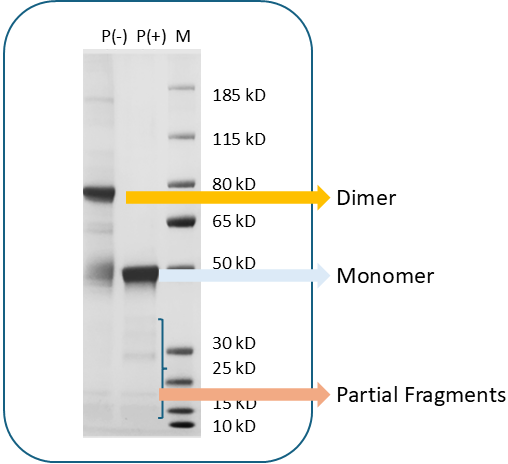
| Molecular Weight | This protein has a predicted molecular weight of 45.3 kDa. Under DTT-reducing conditions, the protein migrates at approximately 50 kDa on SDS-PAGE. |
| Affinity Tag | C-Fc |
| Purity | >90% based on SDS-PAGE under reducing condition |
| Regulatory Status | RUO |
| Formulation | 1xPBS with 5mM DTT, pH 7.4 (0.2 μm filtered) |
| Endotoxin level | Not tested |
| Protein Concentration | 25µg size is bottled at 0.2mg/mL concentration. 100 µg size is supplied at a lot-specific concentration. |
| Storage and Handling | Briefly centrifuge the vial upon receipt. An unopened vial can be stored at 4°C for up to 2 weeks, or at -20°C or below for up to six months. The protein may be further diluted to 0.1 mg/mL using 0.22 µm-filtered PBS buffer (pH 7.4). For long-term storage, the diluted stock solution should be aliquoted and stored at ≤ –70°C to minimize freeze-thaw cycles. If additional dilution is required, carrier proteins such as FBS or BSA should be added to maintain protein stability. |
| Research Areas | Metabolism |
SURF1 (Surfeit locus protein 1) is a nuclear-encoded protein localized to the inner mitochondrial membrane, where it plays a critical role in the biogenesis of cytochrome c oxidase (COX), also known as Complex IV of the mitochondrial respiratory chain. SURF1 functions as an assembly factor rather than a catalytic subunit. It facilitates the proper maturation and incorporation of mitochondrially encoded COX subunits—particularly COX I—into the functional holoenzyme. By supporting Complex IV assembly, SURF1 is essential for efficient oxidative phosphorylation and ATP production.
Structurally, human SURF1 is a relatively small protein of approximately 300 amino acids containing a mitochondrial targeting sequence at its N-terminus and two predicted transmembrane helices that anchor it in the inner mitochondrial membrane. The bulk of the protein extends into the intermembrane space, where it interacts with assembling COX subunits and other assembly factors. High-resolution structural data remain limited compared to catalytic respiratory chain components, but biochemical and mutational analyses indicate that SURF1 stabilizes early assembly intermediates of Complex IV. SURF1 does not bind classical signaling ligands; instead, it engages in protein–protein interactions with COX assembly intermediates and may transiently associate with heme a–containing subunits during maturation.
Pathogenic variants in the SURF1 gene are a well-established cause of Leigh syndrome, a severe, early-onset neurodegenerative mitochondrial disorder. Patients with SURF1 deficiency exhibit markedly reduced Complex IV activity, leading to impaired oxidative phosphorylation, lactic acidosis, developmental regression, and characteristic bilateral lesions in the basal ganglia and brainstem. Unlike some other genetic causes of Leigh syndrome, SURF1-associated disease often presents with isolated Complex IV deficiency, highlighting its specific role in COX assembly.
Therapeutically, SURF1 is an active area of investigation in mitochondrial medicine. Current management of SURF1-related Leigh syndrome is largely supportive, but experimental approaches include gene therapy to restore functional SURF1 expression in affected tissues. Preclinical studies using viral vectors have demonstrated partial rescue of Complex IV activity in model systems. Additionally, metabolic support strategies—such as cofactor supplementation and interventions that enhance mitochondrial biogenesis—are being explored. As understanding of mitochondrial gene delivery improves, SURF1 represents a promising target for precision therapies aimed at correcting respiratory chain deficiencies.
Human SURF1 Protein (C-Fc) TDS
Have a product or application question? Consult our FAQs or contact us.