| Cat # | Size | Price | Quantity | |
|---|---|---|---|---|
| 602201 | 25 ug | $145 | ||
| 602202 | 100 ug | $295 |
| Application | ELISA, BLI |
|---|---|
| Format | Liquid, Purified |
| Expression Host | CHO |
| Target Name | TIM3, HAVCR2, TIMD3, FLJ14428, KIM3 |
| Species | Human |
| Accession Number | Q8TDQ0 |
| Sources | Recombinant human Tim-3 protein (Ser22-Arg200) with C-terminus His-Avi tag was expressed in CHO Cells. |
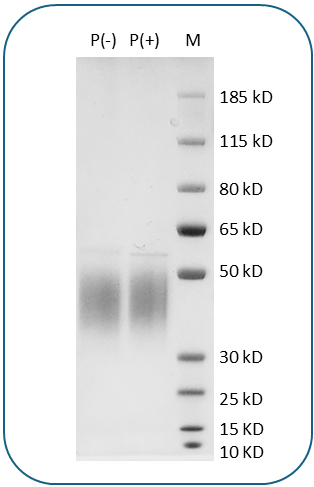
| Molecular Weight | This protein has a predicted molecular weight of 23.7 kDa. Under DTT-reducing conditions, the protein migrates at approximately 45 kDa on SDS-PAGE. |
| Affinity Tag | C-His-Avi |
| Purity | >95% based on SDS-PAGE under reducing condition |
| Regulatory Status | RUO |
| Formulation | 1xPBS buffer, pH7.4, 0.22 µm filtered |
| Endotoxin level | Not tested |
| Protein Concentration | 25µg size is bottled at 0.2mg/mL concentration. 100 µg size is supplied at a lot-specific concentration. |
| Storage and Handling | Briefly centrifuge the vial upon receipt. An unopened vial can be stored at 4°C for up to 2 weeks, or at -20°C or below for up to six months. The protein may be further diluted to 0.1 mg/mL using 0.22 µm-filtered PBS buffer (pH 7.4). For long-term storage, the diluted stock solution should be aliquoted and stored at ≤ –70°C to minimize freeze-thaw cycles. If additional dilution is required, carrier proteins such as FBS or BSA should be added to maintain protein stability. |
| Research Areas | Immune Checkpoints, Th1 cells, Tregs, NK cells, conventional Dendritic cells, Macrophages, Monocytes, T cell Exhaustion, Autoimmunity, Cancer Immunology |
T cell immunoglobulin and mucin domain–containing protein 3 (Tim-3), also known as HAVCR2, is an inhibitory immune checkpoint receptor expressed on activated T cells, regulatory T cells (Tregs), natural killer (NK) cells, dendritic cells, and monocytes. Tim-3 plays a central role in regulating immune tolerance and limiting excessive inflammation. In chronic infection and cancer, sustained Tim-3 expression is a hallmark of T cell exhaustion, where effector T cells progressively lose proliferative capacity and cytokine production. Through inhibitory signaling pathways, Tim-3 dampens T cell receptor (TCR) signaling and modulates innate immune responses.
Structurally, Tim-3 is a type I transmembrane glycoprotein composed of an N-terminal immunoglobulin variable (IgV) domain, a mucin-like stalk region rich in O-linked glycosylation sites, a single transmembrane domain, and a cytoplasmic tail. Unlike PD-1, Tim-3 lacks classical ITIM or ITSM motifs; instead, its cytoplasmic tail contains conserved tyrosine residues that mediate signaling through adaptor proteins. In the absence of ligand engagement, the adaptor Bat3 associates with the cytoplasmic tail and maintains T cell activity. Ligand binding promotes Bat3 dissociation and recruitment of inhibitory signaling complexes, resulting in attenuated immune responses.
Tim-3 interacts with multiple ligands, reflecting its context-dependent functions. Key ligands include galectin-9, which can induce apoptosis of Th1 cells; phosphatidylserine, facilitating clearance of apoptotic cells; CEACAM1, which cooperatively regulates T cell inhibition; and HMGB1, modulating innate immune activation. These diverse interactions allow Tim-3 to regulate both adaptive and innate immunity.
Dysregulation of Tim-3 is implicated in cancer, chronic viral infections (such as HIV and hepatitis), autoimmune disorders, and inflammatory diseases. In tumors, Tim-3 is frequently co-expressed with PD-1 on exhausted T cells, contributing to immune escape. Elevated Tim-3 expression can also be observed in certain leukemias, where it may mark leukemic stem cells. Conversely, insufficient inhibitory signaling may exacerbate autoimmunity.
Therapeutically, Tim-3 is an emerging target in immuno-oncology. Monoclonal antibodies that block Tim-3 are being evaluated in clinical trials, often in combination with PD-1/PD-L1 inhibitors to overcome resistance to checkpoint blockade. Beyond oncology, modulating Tim-3 signaling may offer strategies to rebalance immune responses in chronic infection or autoimmune disease. As understanding of its signaling network deepens, Tim-3 remains a promising target for next-generation immune therapies.
Human Tim-3 (CD366) Protein (C-His-Avi) TDS
Human Tim-3 (CD366) Protein (C-His)
Biotin Human Tim-3 (CD366) Protein (C-His-Avi)
Have a product or application question? Consult our FAQs or contact us.