| Cat # | Size | Price | Quantity | |
|---|---|---|---|---|
| 806601 | 25 ug | $145 | ||
| 806602 | 100 ug | $295 |
| Application | ELISA, BLI |
|---|---|
| Format | Liquid, Purified |
| Expression Host | CHO |
| Target Name | EPCAM, TROP1, TACSTD1, CD326, DIAR5, EGP2, EGP314, EGP40, ESA, GA733-2, HNPCC8, HNPCC-8, KS1, 4, KSA, M4S1, MIC18, MK1 |
| Species | Human |
| Sources | Recombinant Human Trop1 (Gln24-Lys265) with C-terminus Fc-Avi tag is expressed in CHO cell. |
| Accession Number | P16422 |
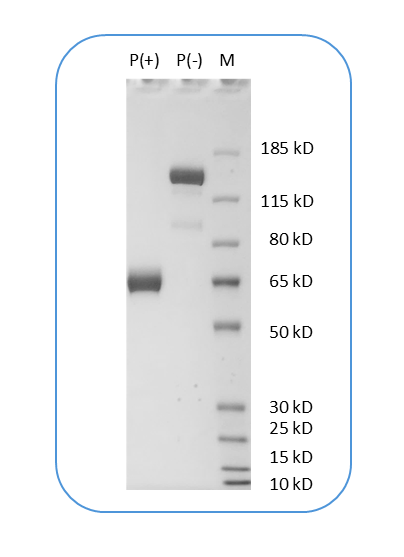
| Molecular Weight | The protein has a predicted molecular weight of 55.7 kDa. Under DTT-reducing conditions, it migrates at approximately 60-65 kDa on SDS-PAGE. |
| Affinity Tag | C-Fc-Avi |
| Purity | >95% based on SDS-PAGE under reducing condition |
| Regulatory Status | RUO |
| Formulation | 1xPBS buffer, pH7.4, 0.22 µm filtered |
| Endotoxin level | Not tested |
| Protein Concentration | 25µg size is bottled at 0.2mg/mL concentration. 100 µg size is supplied at a lot-specific concentration. |
| Storage and Handling | Briefly centrifuge the vial upon receipt. An unopened vial can be stored at 4°C for up to 2 weeks, or at -20°C or below for up to six months. The protein may be further diluted to 0.1 mg/mL using 0.22 µm-filtered PBS buffer (pH 7.4). For long-term storage, the diluted stock solution should be aliquoted and stored at ≤ –70°C to minimize freeze-thaw cycles. If additional dilution is required, carrier proteins such as FBS or BSA should be added to maintain protein stability. |
| Research Areas | Adhesion Molecules, Epithelial cells, Cancer Marker, Cancer Stem cells, Cancer Immunology |
Epithelial cell adhesion molecule (EpCAM), also known as CD326, TACSTD1, or EGP-2, is a type I transmembrane glycoprotein that plays crucial roles in cell adhesion, proliferation, migration, and differentiation. EpCAM is predominantly expressed on the basolateral surface of most normal epithelial tissues, where it mediates calcium-independent homophilic cell-cell adhesion. Beyond its structural role, EpCAM functions as a signaling molecule that regulates cell proliferation and stem cell maintenance. Upon regulated intramembrane proteolysis by ADAM17 and presenilin-2/γ-secretase, EpCAM releases an intracellular domain (EpICD) that translocates to the nucleus and associates with transcription factors to promote expression of genes involved in cell cycle progression, including c-myc and cyclin D1.
Structurally, EpCAM is a 40 kDa protein consisting of an extracellular domain with two epidermal growth factor-like repeats and a thyroglobulin-like domain, a single transmembrane region, and a short cytoplasmic tail. The extracellular domain mediates homophilic interactions between EpCAM molecules on adjacent cells, forming cis-dimers on the same cell surface and trans-interactions between neighboring cells. The cytoplasmic domain contains binding sites for α-actinin and other cytoskeletal proteins, linking EpCAM to the actin cytoskeleton and enabling its role in cell adhesion and migration.
EpCAM primarily functions through homophilic binding (EpCAM-EpCAM interactions), though it can also interact with claudins and other tight junction proteins to modulate epithelial barrier function. The protein's signaling activity is regulated by proteolytic cleavage rather than traditional ligand-receptor mechanisms. EpCAM also interacts intracellularly with β-catenin and components of the Wnt signaling pathway, influencing stem cell properties and epithelial-mesenchymal transition.
In disease contexts, EpCAM is overexpressed in numerous epithelial cancers, including colorectal, breast, lung, pancreatic, ovarian, and gastric carcinomas, where high expression correlates with aggressive tumor behavior, metastasis, and poor prognosis. EpCAM is also a marker of cancer stem cells in several tumor types. Therapeutically, EpCAM has been extensively targeted through multiple approaches. Catumaxomab, a trifunctional bispecific antibody targeting EpCAM and CD3, was approved for malignant ascites treatment. EpCAM-directed CAR-T cell therapies are under investigation for solid tumors, and the molecule serves as a target for circulating tumor cell detection and isolation. Additionally, EpCAM-targeted antibody-drug conjugates and vaccines are in clinical development, establishing EpCAM as an important biomarker and therapeutic target in oncology.
Human Trop1/EpCAM Protein (C-Fc-Avi) TDS
Human Trop1/EpCAM Protein (C-His-Avi)
Biotin Human Trop1/EpCAM Protein (C-His-Avi)
Human Trop1/EpCAM Protein (C-His)
PE Human Trop1/EpCAM Protein (C-His)
APC Human Trop1/EpCAM Protein (C-His)
Biotin Human Trop1/EpCAM Protein (C-Fc-Avi)
Human Trop1/EpCAM Protein (C-Fc)
PE Human Trop1/EpCAM Protein (C-Fc)
APC Human Trop1/EpCAM Protein (C-Fc)
Have a product or application question? Consult our FAQs or contact us.