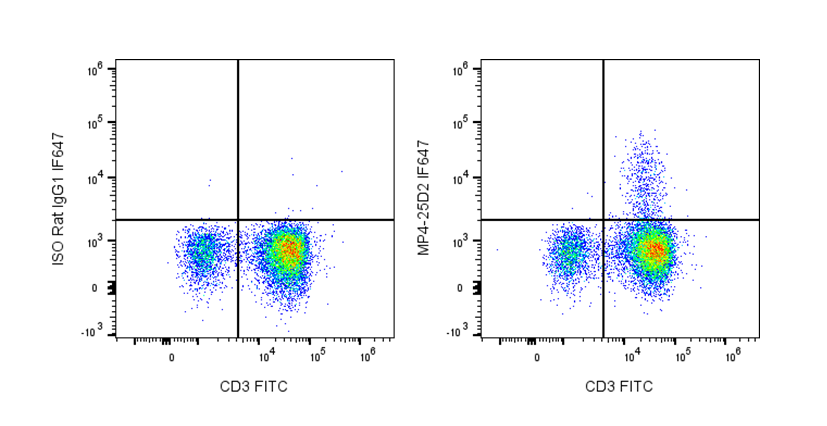
| Cat # | Size | Price | Quantity | |
|---|---|---|---|---|
| 110702 | 25 tests | $95 | ||
| 110703 | 100 tests | $195 |
| Clone | MP4-25D2 |
|---|---|
| Application | Intracellular Flow Cytometry |
| Reactivity | Human |
| Format | iF647 |
| Target Name | IL-4, Interleukin-4, MCGF-2 (Mast cell growth factor-2), MFF (Macrophage fusion factor), TCGF-2 (T cell growth factor-2) |
| Isotype | Rat IgG1 |
| Antibody Type | Monoclonal |
| Regulatory Status | RUO |
| Formulation | Phosphate-buffered solution, pH 7.2, containing 0.09% sodium azide and 0.2% (w/v) BSA |
| Protein Concentration | Supplied at a lot-specific concentration. |
| Storage&Handling | The antibody solution should be stored undiluted between 2°C and 8°C, and protected from prolonged exposure to light. Do not freeze. |
| Recommended Usage | For flow cytometric staining, it is recommended to use 5 µL of this reagent per 0.5-1.0 million cells in a 100 µL volume. Optimal reagent performance should be determined by titration for each specific application. iF647 has an excitation max at 656 nm and an emission max at 670 nm. |
| Excitation Laser | Red Laser (633 nm) |
| RRID | AB_3738951 |
| Research Areas | Cytokines, Allergy, B cell Activation, Antibody Class Switching, Th2 Polarization, Th2 cells, Infectious Diseases |
| See All Formats | Clone MP4-25D2 |
Interleukin-4 (IL-4) is a pleiotropic cytokine that plays a central role in shaping immune responses, particularly those associated with type 2 immunity. It is produced mainly by activated CD4+ T helper 2 (Th2) cells, as well as by mast cells, basophils, eosinophils, and innate lymphoid cells. IL-4 is best known for driving the differentiation of naïve CD4+ T cells into Th2 cells, thereby promoting immune programs involved in defense against helminths and in allergic inflammation.
Structurally, IL-4 is a small, secreted glycoprotein of approximately 15-17 kDa that adopts a compact four–α-helix bundle characteristic of many cytokines in the hematopoietin family. IL-4 signals through a heterodimeric receptor complex composed of the IL-4 receptor alpha chain (IL-4Rα) paired with either the common gamma chain (γc) to form the type I IL-4 receptor, or with IL-13 receptor alpha 1 (IL-13Rα1) to form the type II receptor. Engagement of these receptor complexes initiates intracellular signaling primarily via the JAK-STAT pathway, with STAT6 acting as a key transcriptional mediator.
The functional “ligand” of IL-4 receptors is IL-4 itself, although IL-13 can also signal through the type II IL-4 receptor due to shared receptor subunits and overlapping biological effects. Through receptor engagement, IL-4 influences a wide array of immune cell functions. It stimulates B cell proliferation and promotes immunoglobulin class switching to IgE and IgG1 in mice, enhances expression of MHC class II and co-stimulatory molecules, and drives alternative (M2) activation of macrophages, which are associated with tissue repair and modulation of inflammation.
IL-4 plays a prominent role in disease, particularly in allergic and atopic conditions such as asthma, allergic rhinitis, and atopic dermatitis. Excessive or dysregulated IL-4 signaling contributes to elevated IgE production, eosinophilic inflammation, and airway hyperresponsiveness. IL-4 is also involved in fibrotic diseases through its effects on macrophages and fibroblasts. In cancer, IL-4-driven macrophage polarization may support tumor growth in certain contexts by promoting immunosuppressive microenvironments.
Therapeutically, IL-4 signaling has become an important target in immune-mediated disease. Biologic agents that block IL-4Rα, thereby inhibiting both IL-4 and IL-13 signaling, have demonstrated significant clinical benefit in allergic and inflammatory disorders. Conversely, controlled manipulation of IL-4 pathways is being explored to enhance tissue repair or modulate immune responses, highlighting IL-4’s dual relevance as both a driver of pathology and a potential therapeutic lever.
iF647 Rat IgG1 Isotype Control Antibody
iF647 Anti-Human IL-4 Antibody TDS
Intracellular Flow Cytometry Protocol
Anti-Human IL-4Rα (CD124) (Dupilumab Biosimilar), Clone Dupilumab
Have a product or application question? Consult our FAQs or contact us.