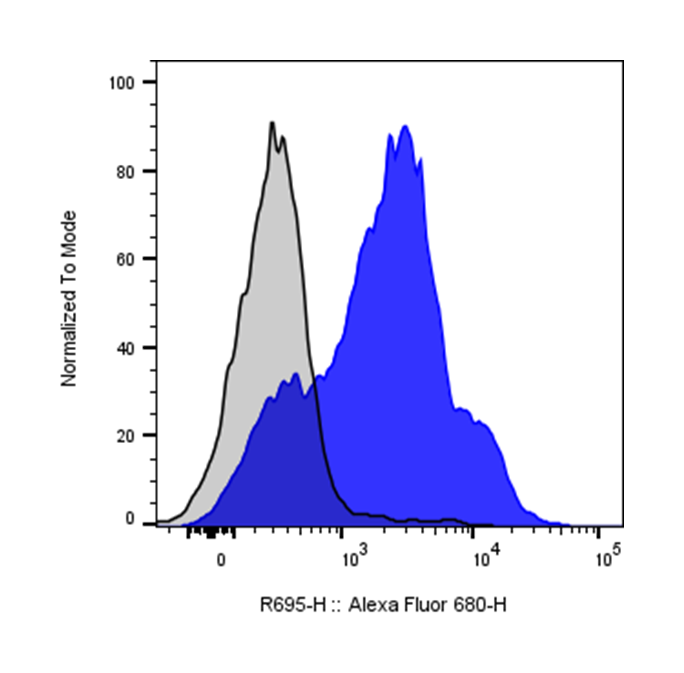
| Cat # | Size | Price | Quantity | |
|---|---|---|---|---|
| 113203 | 25 tests | $80 | ||
| 113204 | 100 tests | $210 |
| Clone | FIB504 |
|---|---|
| Application | Flow Cytometry |
| Reactivity | Human |
| Format | iF647 |
| Target Name | Integrinβ7, β7 Integrin, integrin βp, ITGB7 |
| Isotype | Rat IgG2a |
| Antibody Type | Monoclonal |
| Regulatory Status | RUO |
| Formulation | Phosphate-buffered solution, pH 7.2, containing 0.09% sodium azide and 0.2% (w/v) BSA |
| Protein Concentration | Supplied at a lot-specific concentration. |
| Storage&Handling | The antibody solution should be stored undiluted between 2°C and 8°C, and protected from prolonged exposure to light. Do not freeze. |
| Recommended Usage | For flow cytometric staining, it is recommended to use 5 µL of this reagent per 0.5-1.0 million cells in a 100 µL volume. Optimal reagent performance should be determined by titration for each specific application. iF647 has an excitation max at 656 nm and an emission max at 670 nm. |
| Excitation Laser | Red Laser (633 nm) |
| Research Areas | Adhesion Molecules, Lymphocyte Migration, Lymphocyte Homing, IBD, T cells, B cells |
| See All Formats | Clone FIB504 |
Integrin β7 is a transmembrane adhesion molecule that plays a central role in lymphocyte trafficking, particularly to gut-associated lymphoid tissues. It forms heterodimers with α4 or αE integrin subunits, generating the α4β7 and αEβ7 integrins. These complexes are critical for directing immune cells to specific tissue sites, especially the intestinal mucosa, where they contribute to immune surveillance and mucosal immunity.
Structurally, integrin β7 is a type I transmembrane protein composed of a large extracellular domain, a single-pass transmembrane segment, and a short cytoplasmic tail. The extracellular region participates in ligand binding and undergoes conformational changes that regulate affinity and signaling. Like other integrins, β7 does not function alone but pairs with α subunits to form functional receptors. These heterodimers can switch between inactive and active conformations, allowing dynamic regulation of cell adhesion and migration.
The primary ligands for integrin β7-containing complexes include mucosal addressin cell adhesion molecule-1 (MAdCAM-1), which binds α4β7, and E-cadherin, which binds αEβ7. Interaction with MAdCAM-1 facilitates lymphocyte homing to the gut, while binding to E-cadherin promotes retention of lymphocytes within epithelial tissues. These ligand interactions are essential for maintaining immune balance in mucosal environments.
In disease, dysregulation of integrin β7-mediated trafficking is strongly associated with inflammatory bowel diseases (IBD), such as Crohn’s disease and ulcerative colitis. Excessive recruitment of lymphocytes to the intestinal mucosa contributes to chronic inflammation and tissue damage. Integrin β7 is also implicated in certain infections and may play a role in tumor immunity within mucosal tissues.
Therapeutically, integrin β7 is an established target for treating IBD. Monoclonal antibodies that block α4β7, such as vedolizumab, prevent lymphocyte migration into the gut, thereby reducing inflammation while sparing systemic immunity. This gut-selective mechanism has made β7-targeted therapies an important advancement in managing chronic inflammatory diseases with improved safety profiles compared to broader immunosuppressive agents.
iF647 Rat IgG2a Isotype Control Antibody
iF647 Anti-Human/Mouse Integrin β7 Antibody TDS
Have a product or application question? Consult our FAQs or contact us.