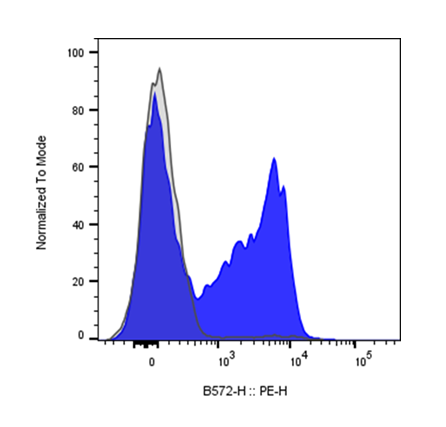
| Cat # | Size | Price | Quantity | |
|---|---|---|---|---|
| 107309 | 25 tests | $80 | ||
| 107310 | 100 tests | $220 |
| Clone | 197AM2a |
|---|---|
| Application | Flow Cytometry |
| Reactivity | Human |
| Format | PE |
| Target Name | CD197, CCR7, BLR2, CDw197, EBI1, CMKBR7 |
| Isotype | Mouse IgG2a |
| Antibody Type | Monoclonal |
| Regulatory Status | RUO |
| Formulation | Phosphate-buffered solution, pH 7.2, containing 0.09% sodium azide and 0.2% (w/v) BSA |
| Protein Concentration | Supplied at a lot-specific concentration. |
| Storage and Handling | The antibody solution should be stored undiluted between 2°C and 8°C, and protected from prolonged exposure to light. Do not freeze. |
| Recommended Usage | For flow cytometric staining, it is recommended to use 5 µL of this reagent per 0.5-1.0 million cells in a 100 µL volume. Optimal reagent performance should be determined by titration for each specific application. PE has an excitation max at 565 nm and an emission max at 575 nm. |
| Excitation Laser | Blue Laser (488 nm) Green/Yellow laser (532/561nm) |
| RRID | AB_3738773 |
| Research Areas | Naïve T cells, Tregs, central memory T cells, Effector memory T cells, B cells, mature Dendritic cells, Chemokine receptors, Chemotaxis |
| See All Formats | Clone 197AM2a |
CD197, also known as CCR7 (C-C chemokine receptor type 7), is a G protein–coupled receptor (GPCR) that plays a crucial role in the organization and trafficking of immune cells. This receptor primarily regulates the migration of T cells, B cells, and dendritic cells to lymphoid tissues, thus coordinating immune surveillance and adaptive immune responses. CCR7 is a typical seven-transmembrane GPCR composed of approximately 378 amino acids. It features an extracellular N-terminal region responsible for ligand binding, seven hydrophobic transmembrane helices, three intracellular and extracellular loops, and a cytoplasmic C-terminal domain that interacts with intracellular signaling molecules. Upon ligand binding, CCR7 activates heterotrimeric G proteins that trigger downstream signaling cascades, including PI3K and MAPK pathways, influencing cell migration, survival, and activation. CCR7 primarily binds two chemokines, CCL19 (ELC) and CCL21 (SLC), which are produced in the lymphoid organs and high endothelial venules. These interactions guide lymphocytes and dendritic cells to secondary lymphoid tissues by establishing chemokine gradients. CCL19 and CCL21 binding induces conformational changes in CCR7 that drive chemotaxis, adhesion, and polarization of responding cells.
Aberrant CCR7 signaling has been implicated in multiple pathological conditions. In cancer, CCR7 facilitates metastasis by directing tumor cells to lymph nodes, a common route for early dissemination. Elevated CCR7 expression is particularly noted in breast cancer, melanoma, and colorectal carcinoma. In autoimmune disorders such as rheumatoid arthritis and multiple sclerosis, overexpression of CCR7 contributes to the mislocalization and activation of immune cells that perpetuate inflammation. Moreover, certain pathogens manipulate CCR7 pathways to evade immune detection.
Due to its central role in immune cell trafficking, CCR7 is an attractive therapeutic target. Strategies to modulate CCR7 activity include the development of small-molecule inhibitors, neutralizing antibodies, and chemokine decoys to block pathological migration. Conversely, enhancing CCR7 signaling may improve vaccine efficacy and immune reconstitution by optimizing dendritic cell and T cell homing. Ongoing research continues to explore the receptor’s potential in immunotherapy, cancer metastasis prevention, and autoimmune disease management.
PE Mouse IgG2a Isotype Control Antibody
PE Anti-Human CD197 (CCR7) Antibody TDS
Anti-Human CD197 (CCR7) Antibody, Clone 197AR2a
iF647 Anti-Human CD197 (CCR7) Antibody, Clone 197AR2a
Have a product or application question? Consult our FAQs or contact us.