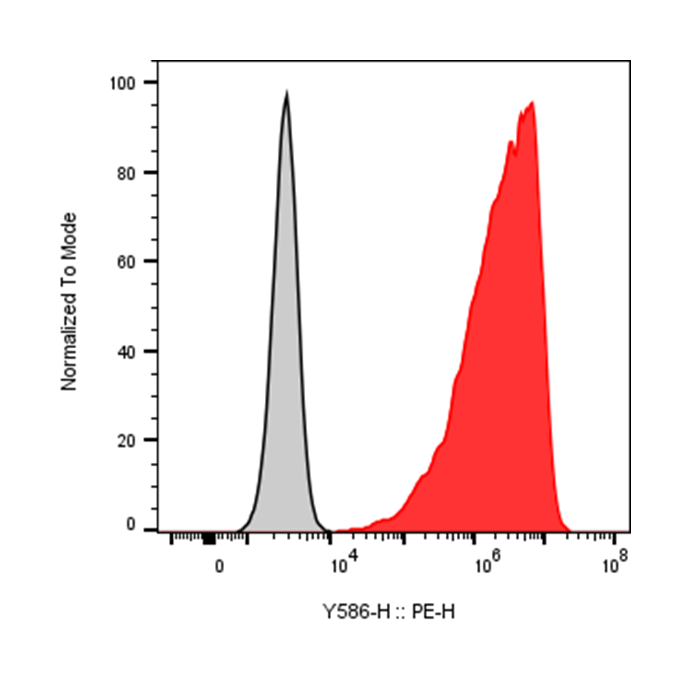
| Cat # | Size | Price | Quantity | |
|---|---|---|---|---|
| 112409 | 25 tests | $150 | ||
| 112410 | 100 tests | $310 |
| Clone | A33 |
|---|---|
| Application | Flow Cytometry |
| Reactivity | Human |
| Format | PE |
| Target Name | GPA33, A33, Glycoprotein A33 |
| Isotype | Human IgG1 |
| Antibody Type | Monoclonal |
| Regulatory Status | RUO |
| Formulation | Phosphate-buffered solution, pH 7.2, containing 0.09% sodium azide and 0.2% (w/v) BSA |
| Protein Concentration | Supplied at a lot-specific concentration. |
| Storage&Handling | The antibody solution should be stored undiluted between 2°C and 8°C, and protected from prolonged exposure to light. Do not freeze. |
| Recommended Usage | For flow cytometric staining, it is recommended to use 5 µL of this reagent per 0.5-1.0 million cells in a 100 µL volume. Optimal reagent performance should be determined by titration for each specific application. PE has an excitation max at 565 nm and an emission max at 575 nm. |
| Excitation Laser | Blue Laser (488 nm) Green/Yellow laser (532/561nm) |
| Research Areas | Cancer Marker, Epithelial cells |
| See All Formats | Clone A33 |
Glycoprotein A33 (GPA33) is a transmembrane cell surface protein predominantly expressed in the intestinal epithelium and is highly conserved across species. It is encoded by the A33 gene and belongs to the immunoglobulin (Ig) superfamily. Under normal physiological conditions, GPA33 is thought to play a role in maintaining epithelial cell adhesion and barrier integrity in the gastrointestinal tract, although its precise biological function remains incompletely understood.
Structurally, GPA33 is a type I membrane protein characterized by two extracellular Ig-like domains, a single transmembrane region, and a short cytoplasmic tail. The extracellular domains suggest a role in cell-cell recognition or adhesion, consistent with its localization in tight junction-associated regions of intestinal epithelial cells. GPA33 is heavily glycosylated, which may contribute to its stability and interactions at the cell surface.
Unlike many receptors, GPA33 does not have well-defined classical ligands. Its function is believed to involve homophilic interactions or participation in multiprotein complexes that regulate epithelial organization. Ongoing research aims to clarify whether it interacts with other adhesion molecules or signaling partners in the intestinal mucosa.
In disease, GPA33 is best known for its strong and consistent expression in colorectal cancer, where it is present in over 95% of primary and metastatic tumors. Importantly, its expression is largely restricted to intestinal tissues, making it an attractive tumor-associated antigen. GPA33 expression is generally maintained even in advanced disease, which enhances its value as a diagnostic and therapeutic target.
Therapeutically, GPA33 has been explored as a target for antibody-based treatments, including monoclonal antibodies, antibody-drug conjugates (ADCs), and radioimmunotherapy. Targeting GPA33 allows selective delivery of cytotoxic agents to colorectal cancer cells while sparing most normal tissues. Several clinical studies have investigated anti-GPA33 antibodies, showing promising tumor targeting with manageable safety profiles. As a result, GPA33 remains an important focus in the development of targeted therapies for colorectal cancer.
PE Human IgG1 Isotype Control Antibody
PE Anti-human GPA33 Antibody TDS
Have a product or application question? Consult our FAQs or contact us.