| Cat # | Size | Price | Quantity | |
|---|---|---|---|---|
| 819903 | 25 ug | $245 | ||
| 819904 | 100 ug | $595 |
| Application | ELISA, BLI |
|---|---|
| Format | Liquid, Biotinylated |
| Expression Host | CHO |
| Target Name | CD32a, FCGR2A, CD32, FCG2 , FCGR2A1, IGFR2 |
| Species | Human |
| Sources | Recombinant CD32a H167 /Fc gamma RIIa (Ala 36 - Ile 218) with C-terminus His-Avi-tag is expressed in CHO cell. This protein was site-specifically labeled with Biotin by BirA ligase. |
| Accession Number | Q92835 |
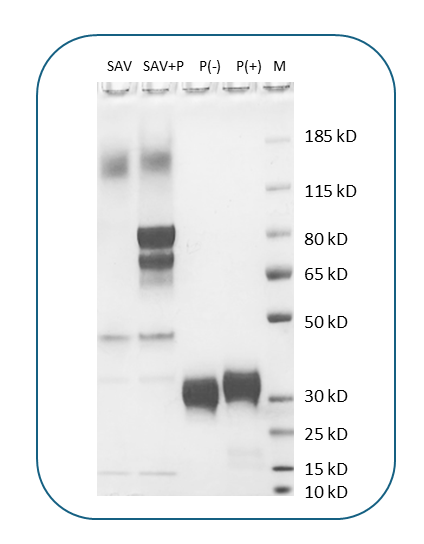
| Molecular Weight | The protein has a predicted molecular weight of 24.4 kDa. Under DTT-reducing conditions, it migrates at approximately 35 kDa on SDS-PAGE. |
| Affinity Tag | C-His-Avi |
| Purity | >95% based on SDS-PAGE under reducing condition |
| Regulatory Status | RUO |
| Formulation | 1xPBS buffer, pH7.4, 0.22 µm filtered |
| Endotoxin level | Less than 0.1 EU/µg protein as determined by the LAL method |
| Protein Concentration | 25µg size is bottled at 0.2mg/mL concentration. 100 µg size is supplied at a lot-specific concentration. |
| Storage and Handling | Briefly centrifuge the vial upon receipt. An unopened vial can be stored at 4°C for up to 2 weeks, or at -20°C or below for up to six months. The protein may be further diluted to 0.1 mg/mL using 0.22 µm-filtered PBS buffer (pH 7.4). For long-term storage, the diluted stock solution should be aliquoted and stored at ≤ –70°C to minimize freeze-thaw cycles. If additional dilution is required, carrier proteins such as FBS or BSA should be added to maintain protein stability. |
| Recommended Usage | For detection, use a secondary reagent with this product. |
| Research Areas | Macrophages, Neutrophils, Platelets, Dendritic Cells, Phagocytosis, Autoimmunity, Infectious Diseases |
CD32A H167 refers to the histidine (H) variant at position 167 of the FcγRIIA (CD32A) receptor, representing one of two common allelic forms resulting from a functionally significant single nucleotide polymorphism. CD32A is the most widespread activating Fc gamma receptor in humans, expressed on monocytes, macrophages, neutrophils, dendritic cells, platelets, and mast cells, where it plays a central role in antibody-mediated immune responses. The receptor binds to the Fc portion of IgG antibodies and mediates critical effector functions including phagocytosis of antibody-opsonized pathogens, antibody-dependent cellular cytotoxicity (ADCC), immune complex clearance, and inflammatory responses. The H167 variant is considered the "high-responder" allele due to its superior binding affinity for certain IgG subclasses, particularly IgG2, compared to the alternative arginine (R167) variant.
Structurally, the H167 variant contains a histidine residue at position 167 within the second extracellular immunoglobulin-like domain (EC2), which forms the primary IgG-binding interface. Histidine is a unique amino acid with an imidazole side chain that can act as both a hydrogen bond donor and acceptor, and its partial positive charge at physiological pH enables favorable electrostatic interactions with the Fc region of IgG antibodies. This creates optimal spatial and chemical complementarity with IgG2, resulting in significantly higher binding affinity compared to the R167 variant. The enhanced binding efficiency of the H167 variant translates to lower activation thresholds and more robust immune responses when IgG2-containing immune complexes are present. The overall receptor architecture, including the transmembrane domain and cytoplasmic immunoreceptor tyrosine-based activation motif (ITAM), remains unchanged, but the improved ligand engagement enhances downstream signaling.
The primary ligands for CD32A H167 are IgG antibodies (IgG1, IgG2, and IgG3) in the form of immune complexes or aggregated antibodies. The H167 variant exhibits particularly high affinity for IgG2, enabling efficient recognition and clearance of IgG2-opsonized pathogens and IgG2-containing immune complexes. This enhanced IgG2 binding is functionally significant because IgG2 antibodies are the predominant response to polysaccharide antigens from encapsulated bacteria, making the H167 variant more effective at mediating protective immunity against these pathogens.
In disease contexts, the CD32A H167 polymorphism confers both protective and potentially detrimental effects depending on the clinical scenario. Individuals carrying the H167 variant show enhanced clearance of immune complexes and improved responses to encapsulated bacterial infections, providing protection against conditions like invasive pneumococcal disease and meningococcal infections. However, the more efficient immune complex clearance may paradoxically reduce the risk of autoimmune diseases like systemic lupus erythematosus (SLE) compared to R167 carriers. In cardiovascular disease, the H167 variant on platelets may influence thrombotic responses. Therapeutically, the H167 polymorphism has important implications for antibody-based cancer immunotherapy. Patients carrying the H167 variant typically show superior responses to therapeutic monoclonal antibodies that rely on FcγRIIA-mediated effector functions, including rituximab for lymphoma, trastuzumab for breast cancer, and cetuximab for colorectal cancer. This has led to pharmacogenomic studies exploring FcγRIIA genotyping as a predictive biomarker for treatment response. Additionally, the H167 variant serves as a benchmark for Fc engineering efforts aimed at developing therapeutic antibodies with enhanced binding to both H167 and R167 variants, ensuring consistent efficacy across all patient populations. Understanding the H167 variant is crucial for personalized medicine approaches in immunotherapy and for optimizing antibody-based treatments in oncology and infectious diseases.
Biotin Human CD32a H167 (FcγRIIA) Protein (C-His-Avi) TDS
Human CD32a H167 (FcγRIIA) Protein (C-His-Avi)
Human CD32a H167 (FcγRIIA) Protein (C-His)
PE Human CD32a H167 (FcγRIIA) Protein (C-His)
PE Human CD32a H167 (FcγRIIA) Protein (C-His)
APC Human CD32a H167 (FcγRIIA) Protein (C-His)
Human CD32a R167 (FcγRIIA) Protein (C-His-Avi)
Biotin Human CD32a R167 (FcγRIIA) Protein (C-His-Avi)
Human CD32a R167 (FcγRIIA) Protein (C-His)
PE Human CD32a R167 (FcγRIIA) Protein (C-His)
Have a product or application question? Consult our FAQs or contact us.