| Cat # | Size | Price | Quantity | |
|---|---|---|---|---|
| 803901 | 25 ug | $145 | ||
| 803902 | 100 ug | $295 |
| Application | ELISA, BLI |
|---|---|
| Format | Liquid, Purified |
| Expression Host | CHO |
| Target Name | CD8A, CD8, Leu2, MAL, p32 |
| Species | Human |
| Sources | Recombinant Human CD8α protein (Ser22-Asp182)with C-terminus His tag is expressed in CHO cells. |
| Accession Number | P01732 |
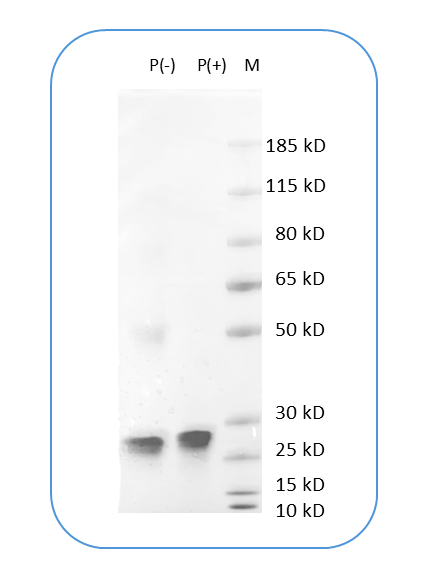
| Molecular Weight | The protein has a predicted molecular weight of 19 kDa. Under DTT-reducing conditions, it migrates at approximately 25-30 kDa on SDS-PAGE prior to conjugation. |
| Affinity Tag | C-His |
| Purity | >95% based on SDS-PAGE under reducing condition |
| Regulatory Status | RUO |
| Formulation | 1xPBS buffer, pH7.4, 0.22 µm filtered |
| Endotoxin level | Not tested |
| Protein Concentration | 25µg size is bottled at 0.2mg/mL concentration. 100 µg size is supplied at a lot-specific concentration. |
| Storage and Handling | Briefly centrifuge the vial upon receipt. An unopened vial can be stored at 4°C for up to 2 weeks, or at -20°C or below for up to six months. The protein may be further diluted to 0.1 mg/mL using 0.22 µm-filtered PBS buffer (pH 7.4). For long-term storage, the diluted stock solution should be aliquoted and stored at ≤ –70°C to minimize freeze-thaw cycles. If additional dilution is required, carrier proteins such as FBS or BSA should be added to maintain protein stability. |
| Research Areas | T cells, T cell Activation, Adaptive Immunity |
CD8 is a cell surface glycoprotein that plays a critical role in cellular immunity. It is most commonly expressed on cytotoxic T lymphocytes (CD8⁺ T cells), although lower levels can also be found on subsets of natural killer (NK) cells and dendritic cells.
Structurally, CD8 exists either as a homodimer of two CD8α chains (CD8αα) or, more commonly on T cells, as a heterodimer composed of CD8α and CD8β chains (CD8αβ). Each chain contains an extracellular immunoglobulin-like domain, a transmembrane region, and a short cytoplasmic tail that associates with intracellular signaling molecules. Functionally, CD8 acts as a co-receptor for the T cell receptor (TCR) during antigen recognition. Its primary ligand is major histocompatibility complex class I (MHC I), which is expressed on nearly all nucleated cells. During immune surveillance, the TCR recognizes peptide antigens presented by MHC I, while CD8 binds to a conserved region of the MHC I molecule. This interaction stabilizes the TCR-peptide-MHC complex and brings the Src-family kinase Lck into proximity with the TCR signaling machinery, thereby enhancing signal transduction and lowering the threshold for T cell activation. Once activated, CD8⁺ T cells differentiate into cytotoxic effector cells capable of directly killing infected or malignant cells. They mediate target cell death primarily through the release of perforin and granzymes, which induce apoptosis, as well as through engagement of death receptor pathways such as Fas-Fas ligand interactions. CD8⁺ T cells also secrete cytokines, including interferon-γ (IFN-γ) and tumor necrosis factor-α (TNF-α), which further shape immune responses and inhibit pathogen replication.
CD8⁺ T cells are essential for protection against viral infections and for immune surveillance against cancer. However, their dysregulation contributes to disease. Insufficient CD8⁺ T cell responses can result in chronic viral infections or tumor immune evasion, while excessive or misdirected activity can cause tissue damage and contribute to autoimmune diseases, such as type 1 diabetes and multiple sclerosis. In chronic infections and cancer, persistent antigen exposure can drive CD8⁺ T cell exhaustion, characterized by reduced effector function and sustained expression of inhibitory receptors.
In therapeutics, CD8⁺ T cells are central to modern immunotherapy. Cancer treatments such as immune checkpoint inhibitors aim to reinvigorate exhausted CD8⁺ T cells, while adoptive cell therapies, including CAR-T and TCR-engineered T cells, harness or enhance CD8⁺ cytotoxic activity. CD8⁺ T cell responses are also a key goal of antiviral vaccines, underscoring their importance in both disease control and therapeutic intervention.
Human CD8α Protein (C-His) TDS
Anti-Human CD3 Antibody, Clone Hit3a
iF700 Anti-Human CD3 Antibody, Clone Hit3a
iF488 Anti-Human CD3 Antibody, Clone OKT3
PerCP/Cyanine5.5 Anti-Human CD3 Antibody, Clone OKT3
Anti-Human CD8a Antibody, Clone 008aAB
iF700 Anti-Human CD8a Antibody, Clone 008aAB
In Vivo Star Anti-Mouse CD8a Antibody, Clone YTS 169.4-m2a
Human CD8α Protein (C-His-Avi)
Biotin Human CD8α Protein (C-His-Avi)
Have a product or application question? Consult our FAQs or contact us.