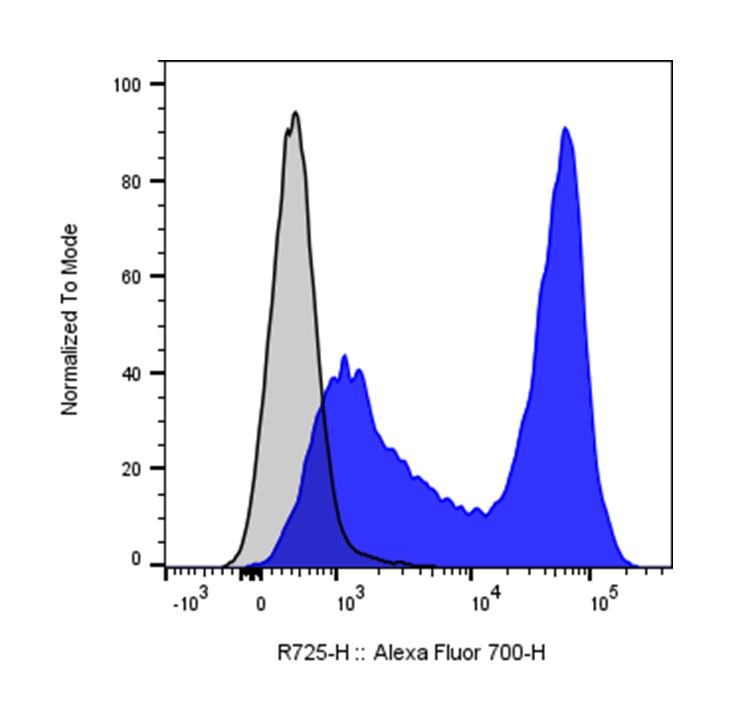
| Cat # | Size | Price | Quantity | |
|---|---|---|---|---|
| 112817 | 25 tests | $105 | ||
| 112818 | 100 tests | $260 |
| Clone | L17F12 |
|---|---|
| Application | Flow Cytometry |
| Reactivity | Human |
| Format | iF700 |
| Target Name | CD5, Leu1, Leu-1, Ly-1, Tp67, T1 |
| Isotype | Mouse IgG2a |
| Antibody Type | Monoclonal |
| Regulatory Status | RUO |
| Formulation | Phosphate-buffered solution, pH 7.2, containing 0.09% sodium azide and 0.2% (w/v) BSA |
| Protein Concentration | Supplied at a lot-specific concentration. |
| Storage&Handling | The antibody solution should be stored undiluted between 2°C and 8°C, and protected from prolonged exposure to light. Do not freeze. |
| Recommended Usage | For flow cytometric staining, it is recommended to use 5 µL of this reagent per 0.5-1.0 million cells in a 100 µL volume. Optimal reagent performance should be determined by titration for each specific application. iF700 has an excitation max at 690 nm and an emission max at 710 nm. |
| Excitation Laser | Red Laser (633 nm) |
| Research Areas | T cells, T cell Activation, Adaptive Immunity |
| See All Formats | Clone L17F12 |
CD5 is a cell surface glycoprotein primarily expressed on T cells and a subset of B cells, particularly B-1a cells. It functions as an important immunomodulatory receptor that helps regulate antigen receptor signaling. In T cells, CD5 acts as a negative regulator of T cell receptor (TCR) signaling, fine-tuning immune responses and maintaining self-tolerance. Similarly, in B cells, CD5 modulates B cell receptor (BCR) signaling and contributes to the control of autoreactive B cell activity.
Structurally, CD5 is a type I transmembrane protein composed of three extracellular scavenger receptor cysteine-rich (SRCR) domains, a single transmembrane region, and a cytoplasmic tail that lacks intrinsic enzymatic activity but contains multiple phosphorylation sites. These sites recruit signaling molecules such as SHP-1 and other phosphatases, enabling CD5 to dampen intracellular signaling cascades triggered by antigen recognition.
CD5 interacts with several proposed ligands, including CD72, a B cell surface protein, and possibly pathogen-associated molecules, although its ligand interactions are not as well defined as those of many other immune receptors. These interactions contribute to its regulatory functions in both innate and adaptive immunity.
In disease, CD5 plays a significant role in autoimmune disorders, infections, and malignancies. Dysregulation of CD5 signaling can lead to enhanced autoreactivity, contributing to diseases such as systemic lupus erythematosus and rheumatoid arthritis. Additionally, CD5 is a diagnostic marker in certain hematologic malignancies, including chronic lymphocytic leukemia (CLL) and mantle cell lymphoma, where it is aberrantly expressed on malignant B cells.
Therapeutically, CD5 is being explored as a target for immune modulation. Strategies include targeting CD5-positive malignant cells in leukemia and lymphoma, as well as modulating CD5 signaling to enhance immune responses in cancer or suppress them in autoimmune diseases. Its dual role in regulating immune activation makes CD5 a promising but complex target for future immunotherapies.
iF700 Mouse IgG2a Isotype Control
iF700 Anti-human CD5 Antibody TDS
Have a product or application question? Consult our FAQs or contact us.