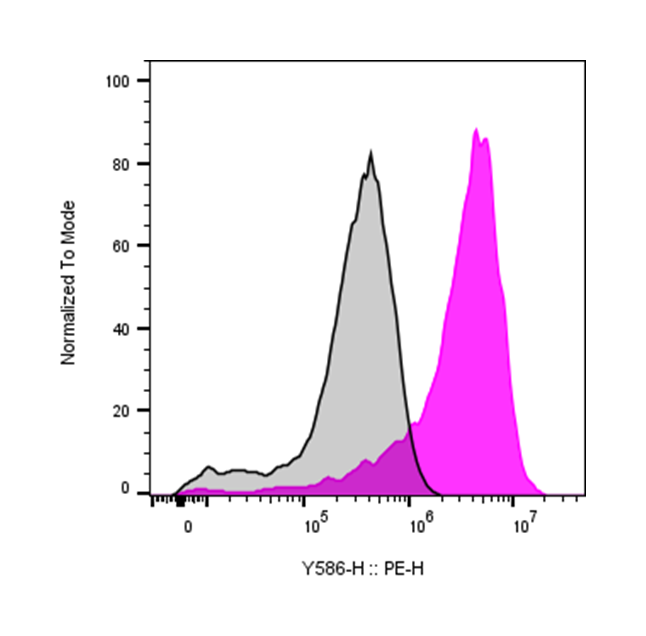
The antibody solution should be stored between 2°C and 8°C
Recommended Usage
For flow cytometric staining, it is recommended to use less than 0.2 µg of this reagent per 0.5-1.0 million cells in a 100 µL volume. Optimal reagent performance should be determined by titration for each specific application.
CD25 is a 55 kDa type I transmembrane glycoprotein and the alpha chain of the high-affinity interleukin-2 receptor (IL-2R). It is expressed on activated T and B cells, progenitor lymphocytes, activated monocytes/macrophages, and a subset of non-stimulated CD4⁺ regulatory T cells (Tregs). CD25 associates with the IL-2 receptor β (CD122) and common γ (CD132) chains to form the functional high-affinity IL-2R complex. Functionally, CD25 is critical for T cell activation, proliferation, and immune regulation. Deficiency of CD25 in mice causes severe autoimmunity and lethal lymphoproliferative disorders, mirroring defects seen in FOXP3 deficiency. In humans, genetic studies and case-control analyses have linked CD25 to autoimmune diseases such as Graves’ disease, often accompanied by elevated soluble IL-2Rα (sIL-2Rα). Its role in immune regulation also makes it a target in certain cancer immunotherapies.
How do I determine the optimal antibody concentration/titer for my experiment?
We recommend titrating each new antibody lot on your own cell type and instrument, since optimal concentration depends on cell density, target expression level, and cytometer sensitivity. Suggested starting dilutions or test sizes (e.g., µg or µl per 10^6 cells) are provided on the product page as a starting reference point, not a fixed requirement.
Can these antibodies be used for intracellular or intranuclear staining, or only surface staining?
Intended use (surface, intracellular, or both) is specified per product, indicated under Application. The appropriate Related Protocol is linked for each product. If you need to detect both surface and intracellular markers in the same panel, confirm each antibody's compatibility with your fixation/permeabilization protocol before combining them.
What controls should I use alongside these antibodies?
Matched isotype controls (same host species, isotype, and conjugate) are available for most clones to help distinguish specific binding from background/non-specific staining and are linked on each product page. Unstained, single-color compensation, and fluorescence-minus-one (FMO) controls are also recommended, especially for multicolor panel design.
Can I combine InnoCyto Flow Cytometry antibodies into a multicolor panel?
Yes — antibodies across our catalog are designed to be panel-compatible, and conjugate options are offered specifically to support multiplexing. When building a panel, pair bright fluorophores with low-expression targets, avoid excessive spectral overlap, and confirm compensation is set up correctly for your specific fluorochrome combination. Use our Panel Builder to simplify the process.
Have a product or application question? Consult our FAQs or contact us.