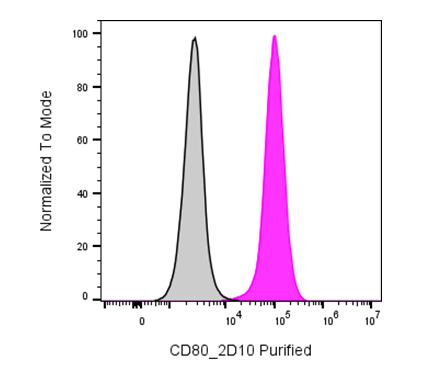
| Cat # | Size | Price | Quantity | |
|---|---|---|---|---|
| 113701 | 25 µg | $50 | ||
| 113702 | 100 µg | $90 |
| Clone | 2D10 |
|---|---|
| Application | Flow Cytometry |
| Reactivity | Human |
| Format | Purified |
| Target Name | CD80, B1, B7-1, BB1 |
| Isotype | Mouse IgG1 |
| Antibody Type | Monoclonal |
| Regulatory Status | RUO |
| Formulation | Phosphate-buffered solution, pH 7.2, containing 0.09% sodium azide |
| Protein Concentration | 0.5 mg/mL |
| Storage&Handling | The antibody solution should be stored between 2°C and 8°C |
| Recommended Usage | For flow cytometric staining, it is recommended to use less than 0.2 µg of this reagent per 0.5-1.0 million cells in a 100 µL volume. Optimal reagent performance should be determined by titration for each specific application |
| Storage & Handling | The antibody solution should be stored between 2°C and 8°C |
| See All Formats | Clone 2D10 |
Human CD80, also known as B7-1, is an important immune costimulatory molecule encoded by the CD80 gene. It belongs to the B7 family of immunoglobulin superfamily proteins and is expressed primarily on antigen-presenting cells, including dendritic cells, monocytes, macrophages, and activated B cells. CD80 plays a central role in regulating T-cell activation by providing costimulatory signals during antigen presentation. By working together with peptide–major histocompatibility complex (MHC) recognition by the T-cell receptor, CD80 helps determine the strength and outcome of adaptive immune responses, including T-cell proliferation, cytokine production, and differentiation.
CD80 is a type I transmembrane glycoprotein with an extracellular region containing two immunoglobulin-like domains, a single transmembrane segment, and a short cytoplasmic tail. Its principal ligands are CD28 and cytotoxic T-lymphocyte-associated protein 4 (CTLA-4, CD152), both expressed on T cells. Interaction with CD28 delivers a positive costimulatory signal that promotes T-cell activation, survival, and expansion. In contrast, binding to CTLA-4 generally inhibits T-cell responses and helps maintain peripheral immune tolerance. The balance between CD80–CD28 costimulation and CD80–CTLA-4 inhibition is therefore essential for controlling immune activity and preventing excessive inflammation.
Dysregulation of CD80-mediated signaling is associated with several diseases. Insufficient costimulation can weaken immune responses against infections and tumors, whereas excessive or improperly regulated signaling may contribute to autoimmune diseases and chronic inflammation. CD80 expression on tumor cells or tumor-associated antigen-presenting cells can influence antitumor immunity, with outcomes depending on interactions with CD28 and CTLA-4 and the surrounding immune environment.
CD80 is an important target in immunotherapy research. CTLA-4-blocking antibodies can enhance T-cell activation partly by disrupting inhibitory interactions involving CD80 and CTLA-4. Conversely, CTLA-4–immunoglobulin fusion proteins, such as abatacept and belatacept, bind CD80 and CD86 to suppress costimulation and are used in selected autoimmune and transplantation settings. Human CD80 is widely studied in immunology, cancer research, and therapeutic development targeting immune regulation.
Mouse IgG1 Isotype Control Antibody
Have a product or application question? Consult our FAQs or contact us.