| Cat # | Size | Price | Quantity | |
|---|---|---|---|---|
| 208401 | 25 µg | $90 | ||
| 208402 | 100 µg | $215 |
| Clone | DEC-205 |
|---|---|
| Application | Flow Cytometry |
| Reactivity | Mouse |
| Format | Purified |
| Target Name | CD205, DEC-205 |
| Isotype | Rat IgG2a |
| Antibody Type | Monoclonal |
| Regulatory Status | RUO |
| Formulation | Phosphate-buffered solution, pH 7.2, containing 0.09% sodium azide |
| Protein Concentration | 0.5 mg/mL |
| Storage & Handling | The antibody solution should be stored between 2°C and 8°C |
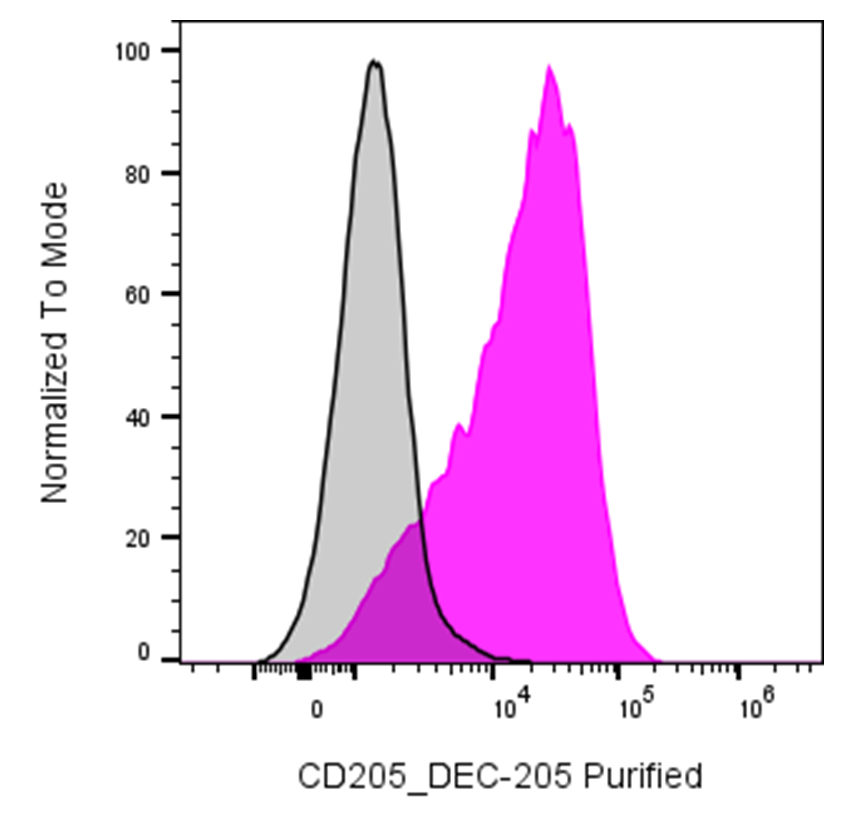
| Recommended Usage | For flow cytometric staining, it is recommended to use less than 0.2 µg of this reagent per 0.5-1.0 million cells in a 100 µL volume. Optimal reagent performance should be determined by titration for each specific application |
| See All Formats | Clone DEC-205 |
CD205, also known as DEC-205 or lymphocyte antigen 75 (LY75), is an endocytic receptor expressed predominantly on dendritic cells and certain other antigen-presenting cell populations. It plays an important role in antigen uptake, processing, and presentation, helping connect innate antigen capture with adaptive immune responses. CD205 efficiently internalizes extracellular material and delivers it to endosomal and lysosomal compartments, where antigens can be processed for presentation to T cells. Depending on the cellular context and accompanying immune signals, CD205-mediated antigen delivery can promote either immune tolerance or effective T-cell activation.
CD205 is a type I transmembrane glycoprotein belonging to the mannose receptor family of C-type lectin-like receptors. Its large extracellular region contains multiple C-type lectin-like domains, a fibronectin type II domain, and an N-terminal cysteine-rich domain. A single transmembrane segment anchors the receptor to the cell membrane, while a cytoplasmic tail contains internalization motifs that facilitate receptor-mediated endocytosis. Unlike classical lectins that bind a single well-defined ligand, CD205 recognizes and internalizes a variety of macromolecules and antigens; its precise binding interactions depend on the molecular target and experimental context.
CD205 contributes to immune regulation and has been investigated in cancer, infectious diseases, and autoimmune disorders. Its role in antigen presentation can influence the development of antigen-specific T-cell responses, while altered dendritic-cell function may affect immune tolerance or pathogen control. CD205 expression on antigen-presenting cells also makes it a useful marker for studying dendritic-cell biology and antigen-processing pathways.
CD205 is of particular interest in targeted immunotherapy and vaccine development. Researchers have developed antibody-based approaches that deliver tumor-associated or pathogen-derived antigens directly to CD205-expressing dendritic cells. When combined with appropriate adjuvants or immune-stimulatory signals, this strategy can enhance antigen presentation and promote antigen-specific T-cell responses. CD205-targeted delivery systems are therefore being explored for therapeutic cancer vaccines and vaccines against infectious diseases, although their clinical effectiveness depends on the antigen, delivery strategy, and immune context.
Rat IgG2a Isotype Control Antibody
Anti-mouse CD205 (DEC-205) Antibody TDS
Have a product or application question? Consult our FAQs or contact us.