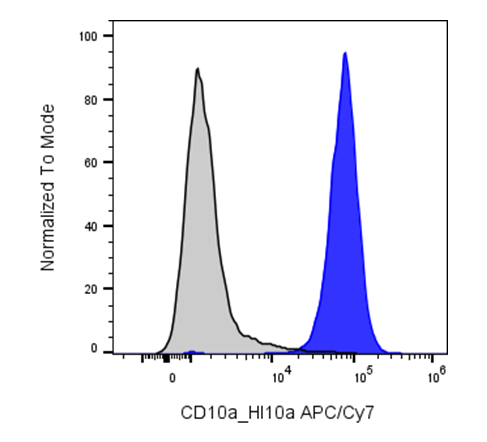
| Cat # | Size | Price | Quantity | |
|---|---|---|---|---|
| 116605 | 25 tests | $130 | ||
| 116606 | 100 tests | $265 |
| Clone | HI10a |
|---|---|
| Application | Flow Cytometry |
| Reactivity | Human |
| Format | APC/Cyanine7 |
| Target Name | CD10, CALLA, Neprilysin |
| Isotype | Mouse IgG1 |
| Antibody Type | Monoclonal |
| Regulatory Status | RUO |
| Formulation | Phosphate-buffered solution, pH 7.2, containing 0.09% sodium azide and 0.2% (w/v) BSA |
| Protein Concentration | Supplied at a lot-specific concentration. |
| Storage&Handling | The antibody solution should be stored undiluted between 2°C and 8°C, and protected from prolonged exposure to light. Do not freeze. |
| Recommended Usage | For flow cytometric staining, it is recommended to use 5 uL of this reagent per 0.5-1.0 million cells in a 100 µL volume. Optimal reagent performance should be determined by titration for each specific application. APC/Cyanine7 has an excitation max at 650 nm and an emission max at 774 nm. |
| Excitation Laser | Red Laser (633 nm) |
| Research Areas | B cells, T cells, Neutrophils, Cancer Marker |
| See All Formats | Clone HI10a |
Human CD10, also known as neprilysin or neutral endopeptidase (NEP), is a zinc-dependent membrane-bound metalloprotease expressed on a variety of cell types, including lymphoid progenitors, epithelial cells, and certain stromal cells. It functions primarily as an ectoenzyme that cleaves and inactivates a wide range of bioactive peptides, such as enkephalins, substance P, bradykinin, and atrial natriuretic peptide, thereby regulating local signaling in tissues.
Structurally, CD10 is a type II transmembrane glycoprotein with a short cytoplasmic N-terminus, a single transmembrane domain, and a large extracellular catalytic domain containing the zinc-binding active site. Its enzymatic activity depends on this extracellular domain, which accommodates diverse peptide substrates rather than classical receptor-ligand interactions.
In disease, CD10 is widely used as a diagnostic marker, particularly in hematologic malignancies such as acute lymphoblastic leukemia (CALLA antigen) and certain lymphomas. It is also implicated in solid tumors, where its expression can correlate with tumor progression or prognosis. Additionally, CD10/neprilysin plays a role in neurodegenerative disorders by degrading amyloid-β peptides, linking it to Alzheimer’s disease.
Therapeutically, CD10 is both a biomarker and a drug target. Neprilysin inhibitors (e.g., in cardiovascular disease) enhance natriuretic peptide activity, while modulation of CD10 activity is being explored in cancer and neurodegeneration for its regulatory effects on peptide signaling.
APC/Cyanine7 Mouse IgG1 Isotype Control Antibody
APC/Cyanine7 Anti-Human CD10 Antibody TDS
Have a product or application question? Consult our FAQs or contact us.