| Cat # | Size | Price | Quantity | |
|---|---|---|---|---|
| 816303 | 25 ug | $245 | ||
| 816304 | 100 ug | $595 |
| Application | ELISA, BLI |
|---|---|
| Format | Liquid, Biotinylated |
| Expression Host | CHO |
| Target Name | CD200R, CRTR2, MOX2R, OX2R |
| Species | Mouse |
| Sources | Recombinant Mouse CD200R1 (Thr26 - Pro238) with C-terminus Fc-Avi-tag is expressed in CHO cell. This protein was site-specifically labeled with Biotin by BirA ligase. |
| Accession Number | Q9ES57 |
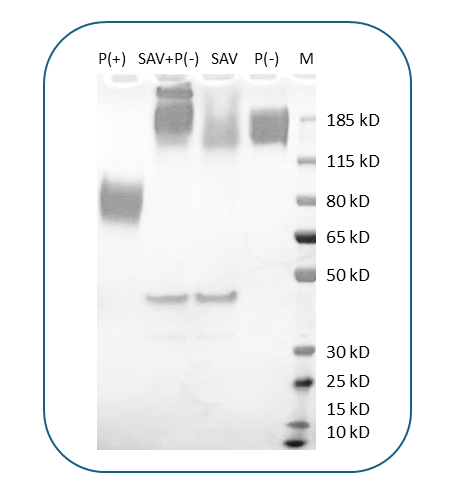
| Molecular Weight | The protein has a predicted molecular weight of 51.5 kDa. Under DTT-reducing conditions, it migrates at approximately 90 kDa on SDS-PAGE. |
| Affinity Tag | C-Fc-Avi |
| Purity | >95% based on SDS-PAGE under reducing condition |
| Regulatory Status | RUO |
| Formulation | 1xPBS buffer, pH7.4, 0.22 µm filtered |
| Endotoxin level | Not tested |
| Protein Concentration | 25µg size is bottled at 0.2mg/mL concentration. 100 µg size is supplied at a lot-specific concentration. |
| Storage and Handling | Briefly centrifuge the vial upon receipt. An unopened vial can be stored at 4°C for up to 2 weeks, or at -20°C or below for up to six months. The protein may be further diluted to 0.1 mg/mL using 0.22 µm-filtered PBS buffer (pH 7.4). For long-term storage, the diluted stock solution should be aliquoted and stored at ≤ –70°C to minimize freeze-thaw cycles. If additional dilution is required, carrier proteins such as FBS or BSA should be added to maintain protein stability. |
| Recommended Usage | For detection, use a secondary reagent with this product. |
| Research Areas | Monocytes, Macrophages, Neutrophils, Mast cells, Eosinophils, Activated T cells, ILC2, Immune Homeostasis |
CD200R (CD200 receptor) is an inhibitory immune receptor that plays a crucial role in regulating immune responses and maintaining immune homeostasis. CD200R is primarily expressed on myeloid cells, including macrophages, dendritic cells, neutrophils, and mast cells, as well as on some T cell and B cell subsets. The receptor functions as a negative regulator of immune activation, delivering inhibitory signals that suppress inflammatory responses, cytokine production, and cellular activation. Upon binding to its ligand CD200, CD200R helps maintain immune tolerance, prevent excessive inflammation, and protect tissues from immune-mediated damage. This regulatory pathway is particularly important in immune-privileged sites such as the brain, eye, and placenta, where it helps prevent destructive inflammatory responses.
Structurally, CD200R is a type I transmembrane glycoprotein of approximately 40-45 kDa belonging to the immunoglobulin superfamily. The extracellular region contains two immunoglobulin-like domains (one IgV-like and one IgC-like domain) that mediate ligand binding. The protein features a single transmembrane domain and a cytoplasmic tail containing immunoreceptor tyrosine-based inhibitory motifs (ITIMs) and an immunoreceptor tyrosine-based switch motif (ITSM). Upon ligand engagement, these motifs become phosphorylated and recruit protein tyrosine phosphatases such as SHP-1 and SHP-2, as well as the lipid phosphatase SHIP. These phosphatases then suppress activating signaling pathways, including those downstream of Toll-like receptors and Fc receptors, thereby dampening immune cell activation and inflammatory responses.
The primary and well-characterized ligand for CD200R is CD200 (also known as OX-2), a widely expressed glycoprotein found on various cell types including neurons, endothelial cells, lymphocytes, and some tumor cells. CD200 is also a member of the immunoglobulin superfamily with structural similarity to CD200R. The CD200-CD200R interaction is highly specific and delivers potent inhibitory signals to myeloid cells. This interaction is critical for regulating microglial activation in the central nervous system, controlling macrophage responses in peripheral tissues, and maintaining immune privilege in specialized anatomical sites.
In disease contexts, dysregulation of the CD200-CD200R axis has been implicated in various pathological conditions. Reduced CD200 expression or impaired CD200R signaling contributes to excessive inflammation in autoimmune diseases, neurodegenerative disorders such as Alzheimer's disease and multiple sclerosis, and chronic inflammatory conditions. Conversely, many cancers exploit this pathway by overexpressing CD200 to suppress antitumor immunity and evade immune surveillance. CD200 overexpression has been observed in chronic lymphocytic leukemia (CLL), acute myeloid leukemia (AML), melanoma, and various solid tumors, where it correlates with immune suppression and poor prognosis. Therapeutically, the CD200-CD200R pathway represents a dual-edged target. For cancer treatment, blocking antibodies against CD200 or CD200R are being developed to disrupt tumor immune evasion and enhance antitumor immunity. Conversely, CD200 agonists or CD200-Fc fusion proteins are being explored as treatments for autoimmune and inflammatory diseases, aiming to enhance inhibitory signaling and reduce pathological inflammation. Additionally, modulating this pathway shows promise in transplantation medicine for promoting graft tolerance and in neurodegenerative diseases for controlling neuroinflammation.
Biotin Mouse CD200R1 Protein (C-Fc-Avi) TDS
Human CD200R1 Protein (C-Fc-Avi)
Biotin Human CD200R1 Protein (C-Fc-Avi)
PE Human CD200R1 Protein (C-Fc)
APC Human CD200R1 Protein (C-Fc)
Mouse CD200R1 Protein (C-His-Avi)
Biotin Mouse CD200R1 Protein (C-His-Avi)
PE Mouse CD200R1 Protein (C-His)
Have a product or application question? Consult our FAQs or contact us.