| Cat # | Size | Price | Quantity | |
|---|---|---|---|---|
| 604501 | 25 ug | $145 | ||
| 604502 | 100 ug | $295 |
| Application | ELISA, BLI |
|---|---|
| Format | Liquid, Purified |
| Expression Host | HEK293 |
| Target Name | Galectin-3, LGALS3, MAC2, Gal-3, Mac-2 antigen |
| Species | Cynomolgus monkey |
| Accession Number | A0A2K5U233 |
| Sources | Recombinant Cynomolgus Monkey Galectin 3 (Ala2-Ile248) with N-His tag is expressed in 293 cells. |
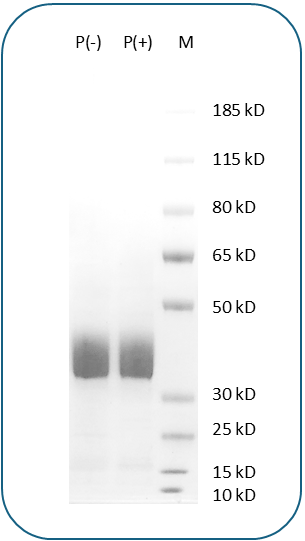
| Molecular Weight | This protein has a predicted molecular weight of 28.2 kDa. Under DTT-reducing conditions, the protein migrates at approximately 35-40 kDa on SDS-PAGE. |
| Affinity Tag | N-His |
| Purity | >95% based on SDS-PAGE under reducing condition |
| Regulatory Status | RUO |
| Formulation | 1xPBS buffer, pH7.4, 0.22 µm filtered |
| Endotoxin level | Not tested |
| Protein Concentration | 25µg size is bottled at 0.2mg/mL concentration. 100 µg size is supplied at a lot-specific concentration. |
| Storage and Handling | Briefly centrifuge the vial upon receipt. An unopened vial can be stored at 4°C for up to 2 weeks, or at -20°C or below for up to six months. The protein may be further diluted to 0.1 mg/mL using 0.22 µm-filtered PBS buffer (pH 7.4). For long-term storage, the diluted stock solution should be aliquoted and stored at ≤ –70°C to minimize freeze-thaw cycles. If additional dilution is required, carrier proteins such as FBS or BSA should be added to maintain protein stability. |
| Research Areas | Adhesion Molecules, Cell Activation, Inflammation, Macrophages, Monocytes, Dendritic cells, Neutrophils, Epithelial cells |
Galectin-3 is a multifunctional β-galactoside–binding lectin encoded by the LGALS3 gene and expressed in a wide range of cell types, including macrophages, epithelial cells, fibroblasts, and certain tumor cells. It plays diverse roles in cell adhesion, immune regulation, apoptosis, fibrosis, and inflammation. Galectin-3 can localize to the cytoplasm, nucleus, cell surface, and extracellular space, enabling it to influence both intracellular signaling pathways and cell–cell or cell–matrix interactions. It is particularly recognized for modulating immune responses and promoting fibrotic tissue remodeling.
Structurally, Galectin-3 is unique among galectins in that it is a chimera-type lectin. It contains a C-terminal carbohydrate recognition domain (CRD) responsible for binding β-galactoside–containing glycoconjugates, and an N-terminal domain rich in proline and glycine residues that mediates oligomerization. Upon ligand binding, Galectin-3 can form pentamers or higher-order multimers, allowing it to crosslink glycosylated receptors on cell surfaces and organize signaling lattices. This multivalency is critical for its ability to regulate receptor clustering and downstream signaling events.
Its primary ligands are glycoproteins and glycolipids bearing N-acetyllactosamine or related β-galactoside structures. Notable binding partners include integrins, laminin, fibronectin, CD45, and various growth factor receptors. Through these interactions, Galectin-3 modulates cell migration, survival, and cytokine production. Intracellularly, it can also interact with anti-apoptotic proteins such as Bcl-2, contributing to cell survival signaling.
Dysregulation of Galectin-3 is implicated in multiple diseases. In cancer, it often promotes tumor progression, angiogenesis, immune evasion, and metastasis. In cardiovascular disease, elevated circulating Galectin-3 is associated with heart failure and adverse remodeling, and it is used clinically as a prognostic biomarker in some settings. Galectin-3 also plays a central role in fibrotic disorders affecting the liver, lung, and kidney, where it drives fibroblast activation and extracellular matrix deposition.
Therapeutically, Galectin-3 is an active target of drug development. Small-molecule inhibitors, modified citrus pectin derivatives, and monoclonal antibodies designed to block its carbohydrate recognition domain are under investigation for cancer and fibrotic diseases. By disrupting Galectin-3–mediated crosslinking and signaling, these approaches aim to reduce inflammation, fibrosis, and tumor-promoting immune suppression, positioning Galectin-3 as a promising target in precision medicine.
Cynomolgus Monkey Galectin 3 Protein (N-His) TDS
Human Galectin 3 protein (N-His)
Mouse Galectin 3 Protein (N-His)
Have a product or application question? Consult our FAQs or contact us.