| Cat # | Size | Price | Quantity | |
|---|---|---|---|---|
| 605101 | 25 ug | $145 | ||
| 605102 | 100 ug | $295 |
| Application | ELISA, BLI |
|---|---|
| Format | Liquid, Purified |
| Expression Host | HEK293 |
| Target Name | OX40L, TNFSF4, CD252, TXGP1, CD134 ligand, , Glycoprotein Gp34 |
| Species | Cynomolgus monkey |
| Accession Number | A0A2K5TTN0 |
| Sources | Recombinant Cynomolgus Monkey OX40L (Gln51-Leu183) with N-terminus Fc tag is expressed in 293 cells |
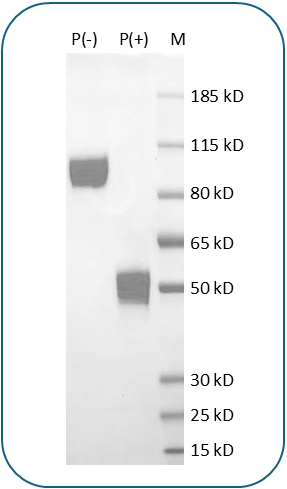
| Molecular Weight | This protein has a predicted molecular weight of 41.4 kDa. Under DTT-reducing conditions, the protein migrates at approximately 50 kDa on SDS-PAGE. |
| Affinity Tag | N-Fc |
| Purity | >95% based on SDS-PAGE under reducing condition |
| Regulatory Status | RUO |
| Formulation | 1xPBS buffer, pH7.4, 0.22 µm filtered |
| Endotoxin level | Not tested |
| Protein Concentration | 25µg size is bottled at 0.2mg/mL concentration. 100 µg size is supplied at a lot-specific concentration. |
| Storage and Handling | Briefly centrifuge the vial upon receipt. An unopened vial can be stored at 4°C for up to 2 weeks, or at -20°C or below for up to six months. The protein may be further diluted to 0.1 mg/mL using 0.22 µm-filtered PBS buffer (pH 7.4). For long-term storage, the diluted stock solution should be aliquoted and stored at ≤ –70°C to minimize freeze-thaw cycles. If additional dilution is required, carrier proteins such as FBS or BSA should be added to maintain protein stability. |
| Research Areas | Co-stimulation, Dendritic cells, B cells, Macrophages, T cell survival, Th1 cells, Th2 cells, Autoimmunity |
OX40 ligand (OX40L), also known as CD252 and encoded by the TNFSF4 gene, is a type II transmembrane protein belonging to the tumor necrosis factor (TNF) superfamily. It is primarily expressed on activated antigen-presenting cells, including dendritic cells, B cells, macrophages, and endothelial cells. OX40L serves as the cognate ligand for OX40 (CD134), a costimulatory receptor expressed on activated CD4⁺ and CD8⁺ T cells. Engagement of OX40 by OX40L delivers a potent secondary signal that enhances T cell proliferation, survival, cytokine production, and memory T cell formation, thereby amplifying adaptive immune responses.
Structurally, OX40L is a ~34 kDa protein with a short N-terminal cytoplasmic domain, a single transmembrane region, and a C-terminal extracellular TNF homology domain. Like other TNF superfamily ligands, OX40L forms stable homotrimers on the cell surface. This trimeric structure is essential for effective receptor clustering and signaling through OX40. Binding of OX40L to OX40 promotes recruitment of TNF receptor–associated factors (TRAFs) to the receptor cytoplasmic tail, activating downstream NF-κB, PI3K–Akt, and MAPK pathways that support T cell expansion and survival.
The principal ligand of OX40L is OX40 (CD134), expressed transiently on activated T cells. Through this interaction, OX40L regulates effector and memory T cell responses and can influence regulatory T cell (Treg) function. While critical for protective immunity against infections, excessive or prolonged OX40–OX40L signaling has been implicated in autoimmune and inflammatory diseases, including asthma, atopic dermatitis, systemic lupus erythematosus, and multiple sclerosis. Genetic variants in TNFSF4 have also been associated with susceptibility to autoimmune disorders.
Therapeutically, OX40L is a target in both immuno-oncology and immune-mediated disease. In cancer, agonistic strategies that enhance OX40 signaling aim to boost antitumor T cell responses, often in combination with checkpoint inhibitors. Conversely, antagonistic antibodies or biologics that block OX40L–OX40 interactions are being developed to dampen pathogenic T cell activation in autoimmune and allergic conditions. By modulating T cell costimulation, OX40L-directed therapies offer a versatile approach to either amplify or restrain immune responses depending on clinical need.
Cynomolgus Monkey OX40L (CD252) Protein (N-Fc) TDS
In Vivo Star Anti-Mouse OX40 Antibody, Clone OX86-m2a
Human OX40 (CD134) Protein (C-His-Avi)
Biotin Human OX40 (CD134) Protein (C-His-Avi)
Human OX40 (CD134) Protein (C-His)
Human OX40L (CD252) Protein (N-Fc)
Mouse OX40L (CD252) Protein (N-Fc)
Have a product or application question? Consult our FAQs or contact us.