| Cat # | Size | Price | Quantity | |
|---|---|---|---|---|
| 817001 | 25 ug | $145 | ||
| 817002 | 100 ug | $295 |
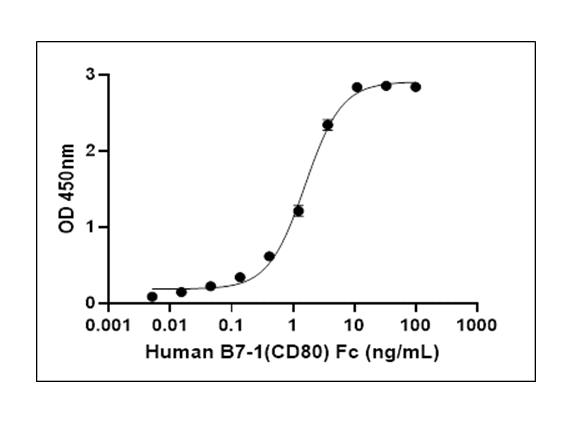
| Application | ELISA, BLI |
|---|---|
| Format | Liquid, Purified |
| Expression Host | CHO |
| Target Name | CD80, B7-1, B7, BB1 |
| Species | Human |
| Sources | Recombinant Human B7-1 (CD80) (Val35-Asn242) with C-terminus Fc-tag is expressed in CHO cell. |
| Accession Number | Q68D85 |
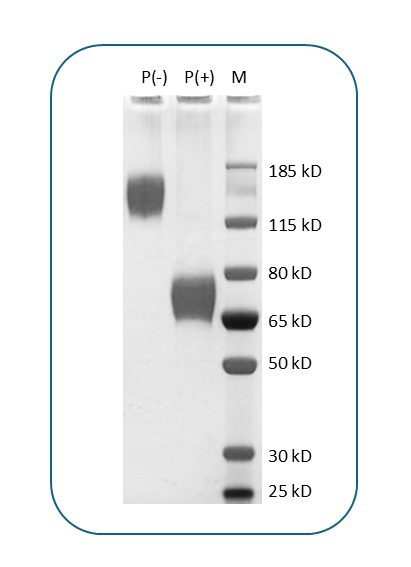
| Molecular Weight | The protein has a predicted molecular weight of 50.1 kDa. Under DTT-reducing conditions, it migrates at approximately 65 kDa on SDS-PAGE. |
| Affinity Tag | C-Fc |
| Purity | >95% based on SDS-PAGE under reducing condition |
| Regulatory Status | RUO |
| Formulation | 1xPBS buffer, pH7.4, 0.22 µm filtered |
| Endotoxin level | Not tested |
| Protein Concentration | 25µg size is bottled at 0.2mg/mL concentration. 100 µg size is supplied at a lot-specific concentration. |
| Storage and Handling | Briefly centrifuge the vial upon receipt. An unopened vial can be stored at 4°C for up to 2 weeks, or at -20°C or below for up to six months. The protein may be further diluted to 0.1 mg/mL using 0.22 µm-filtered PBS buffer (pH 7.4). For long-term storage, the diluted stock solution should be aliquoted and stored at ≤ –70°C to minimize freeze-thaw cycles. If additional dilution is required, carrier proteins such as FBS or BSA should be added to maintain protein stability. |
| Research Areas | Dendritic cells, Macrophages, B cells, Antigen Presentation, Co-stimulation, Immune Checkpoints |
CD80, also known as B7-1, is a transmembrane glycoprotein that functions as a critical costimulatory molecule in the adaptive immune system. CD80 is primarily expressed on antigen-presenting cells (APCs) such as dendritic cells, macrophages, and activated B cells, where it plays an essential role in T cell activation and immune response regulation. The protein provides the necessary "second signal" for T cell activation by binding to receptors on T cells, complementing the primary signal delivered through the T cell receptor (TCR) recognition of peptide-MHC complexes. CD80 is a member of the B7 family of costimulatory molecules and works in concert with its related molecule CD86 (B7-2) to regulate immune responses, though the two proteins have distinct expression patterns and kinetics.
Structurally, CD80 is a type I transmembrane protein of approximately 60 kDa belonging to the immunoglobulin superfamily. The extracellular region contains two immunoglobulin-like domains: an N-terminal IgV-like domain and a membrane-proximal IgC-like domain that mediate receptor binding. The protein also features a single transmembrane domain and a short cytoplasmic tail. The IgV domain is primarily responsible for ligand interactions, while the overall structure allows CD80 to form homodimers on the cell surface, which may enhance its avidity for receptors and strengthen costimulatory signaling. The extracellular domains adopt a characteristic immunoglobulin fold that enables specific recognition by its cognate receptors.
CD80 has two primary ligands with opposing functions: CD28 and CTLA-4 (CD152), both expressed on T cells. Binding to CD28, which is constitutively expressed on naive and activated T cells, delivers positive costimulatory signals that enhance T cell proliferation, survival, cytokine production, and effector function development. This CD80-CD28 interaction is essential for productive T cell responses and immunity. Conversely, binding to CTLA-4, an inhibitory receptor upregulated on activated T cells and constitutively expressed on regulatory T cells, delivers negative signals that suppress T cell activation and maintain immune tolerance. CTLA-4 binds CD80 with higher affinity than CD28, allowing it to outcompete CD28 and dampen immune responses. Additionally, CD80 can interact with PD-L1 (CD274), adding another layer of immune regulation.
In disease contexts, dysregulation of CD80 expression or function contributes to various pathological conditions. Insufficient CD80-mediated costimulation can lead to T cell anergy and impaired immune responses against infections and tumors. Conversely, excessive or inappropriate CD80 expression contributes to autoimmune diseases and transplant rejection by promoting unwanted T cell activation. In cancer, tumor cells and immunosuppressive cells in the tumor microenvironment may manipulate CD80 expression to evade immune surveillance. Therapeutically, the CD80-CD28-CTLA-4 axis has become a cornerstone of cancer immunotherapy. CTLA-4 blocking antibodies such as ipilimumab prevent CTLA-4 from binding to CD80/CD86, thereby enhancing CD28 costimulation and boosting antitumor T cell responses. This approach has achieved remarkable clinical success in melanoma and other cancers. Additionally, CD80-Ig fusion proteins and other CD80-based therapeutics are being explored for modulating immune responses in autoimmune diseases, transplantation, and cancer, establishing CD80 as a pivotal target in immune modulation and therapeutic intervention.
Human B7-1 (CD80) Protein (C-Fc) TDS
Anti-Human CD28 Antibody, Clone 028AB
iF647 Anti-Human CD28 Antibody, Clone 028AB
iF488 Anti-Human CD28 Antibody, Clone CD28.2
FITC Anti-Human CD28 Antibody, Clone CD28.2
Anti-Human CD80 (Galiximab Biosimilar), Clone Galiximab
Human B7-1 (CD80) Protein (C-His-Avi)
Biotin Human B7-1 (CD80) Protein (C-His-Avi)
Human B7-1 (CD80) Protein (C-His)
Have a product or application question? Consult our FAQs or contact us.