| Cat # | Size | Price | Quantity | |
|---|---|---|---|---|
| 804501 | 25 ug | $145 | ||
| 804502 | 100 ug | $295 |
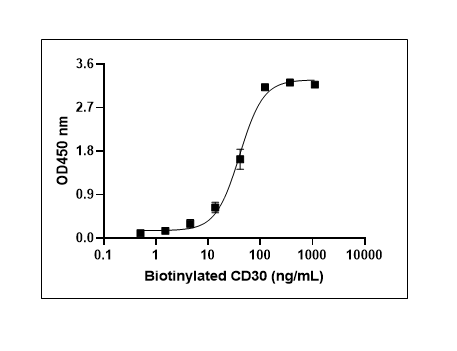
| Application | ELISA, BLI |
|---|---|
| Format | Liquid, Purified |
| Expression Host | CHO |
| Target Name | TNFRSF8, CD30, Ki-1 |
| Species | Human |
| Sources | Recombinant Human CD30 protein (phe19-Lys379) with C-terminus His-Avi tag is expressed in CHO cells. |
| Accession Number | P28908 |
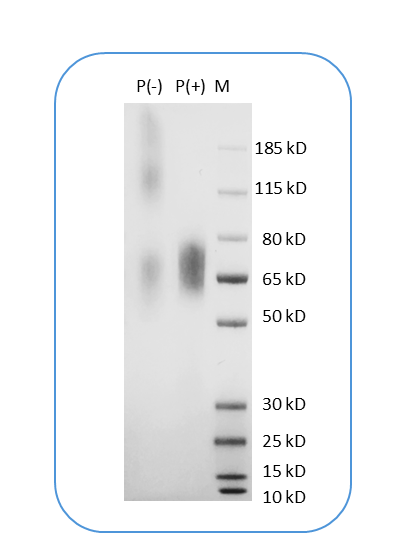
| Molecular Weight | The protein has a predicted molecular weight of 42 kDa. Under DTT-reducing conditions, it migrates at approximately 50-80 kDa on SDS-PAGE. |
| Affinity Tag | C-His-Avi |
| Purity | >95% based on SDS-PAGE under reducing condition |
| Regulatory Status | RUO |
| Formulation | 1xPBS buffer, pH7.4, 0.22 µm filtered |
| Endotoxin level | Not tested |
| Protein Concentration | 25µg size is bottled at 0.2mg/mL concentration. 100 µg size is supplied at a lot-specific concentration. |
| Storage and Handling | Briefly centrifuge the vial upon receipt. An unopened vial can be stored at 4°C for up to 2 weeks, or at -20°C or below for up to six months. The protein may be further diluted to 0.1 mg/mL using 0.22 µm-filtered PBS buffer (pH 7.4). For long-term storage, the diluted stock solution should be aliquoted and stored at ≤ –70°C to minimize freeze-thaw cycles. If additional dilution is required, carrier proteins such as FBS or BSA should be added to maintain protein stability. |
| Research Areas | T cells, B cells, NK cells, Cancer Marker, T cell Activation |
CD30, also known as TNFRSF8, is a type I transmembrane glycoprotein and a member of the tumor necrosis factor receptor (TNFR) superfamily. It is predominantly expressed on activated T and B lymphocytes, and under pathological conditions, on certain lymphoma and carcinoma cells. CD30 functions as a costimulatory receptor involved in regulating cell proliferation, survival, and apoptosis, depending on the context of activation. Its signaling is particularly important in immune cell regulation and inflammatory responses.
Structurally, CD30 consists of three main regions: an extracellular cysteine-rich domain, a single transmembrane domain, and a cytoplasmic tail. The extracellular domain contains multiple cysteine-rich repeats characteristic of TNFR family members, which are essential for ligand binding and receptor oligomerization. The cytoplasmic tail interacts with TNF receptor–associated factor (TRAF) adaptor proteins, initiating downstream signaling cascades such as NF-κB and MAPK pathways. These pathways influence cytokine production and cell fate decisions between survival and programmed cell death.
The primary ligand for CD30 is CD30 ligand (CD30L or CD153), a transmembrane protein belonging to the TNF ligand superfamily. CD30L is expressed mainly on activated T cells, B cells, and some macrophages. Interaction between CD30 and CD30L induces bidirectional signaling: CD30 engagement promotes cell activation or apoptosis depending on cellular context, while reverse signaling through CD30L can modulate immune cell function. The CD30/CD30L axis therefore plays a dual role in immune regulation, contributing to both immune activation and resolution.
In disease contexts, CD30 is clinically significant as a biomarker and therapeutic target. It is highly expressed in certain lymphoid malignancies, including Hodgkin lymphoma and anaplastic large cell lymphoma (ALCL). Its restricted normal expression and high density on tumor cells make CD30 an ideal target for immunotherapy. The most notable example is brentuximab vedotin, an antibody–drug conjugate that binds CD30 and delivers a cytotoxic payload directly to malignant cells. CD30-targeted therapies have achieved remarkable clinical success, leading to durable remissions in relapsed or refractory lymphomas. Moreover, CD30 expression is being explored in non-lymphoid cancers and autoimmune diseases, indicating broader therapeutic potential in modulating immune signaling and inflammation.
Human CD30 (TNFRSF8) Protein (C-His-Avi) TDS
Biotin Human CD30 (TNFRSF8) Protein (C-His-Avi)
Human CD30 (TNFRSF8) Protein (C-His)
PE Human CD30 (TNFRSF8) Protein (C-His)
APC Human CD30 (TNFRSF8) Protein (C-His)
Have a product or application question? Consult our FAQs or contact us.