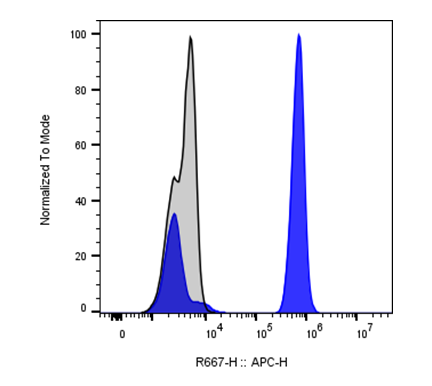
| Cat # | Size | Price | Quantity | |
|---|---|---|---|---|
| 114001 | 25 tests | $150 |
| Clone | Belantamab |
|---|---|
| Application | Flow Cytometry |
| Reactivity | Human |
| Format | iF647 |
| Target Name | BCMA, BCM, TNFRSF17, CD269 |
| Isotype | Human IgG1 |
| Antibody Type | Monoclonal |
| Regulatory Status | RUO |
| Formulation | Phosphate-buffered solution, pH 7.2, containing 0.09% sodium azide and 0.2% (w/v) BSA |
| Protein Concentration | Supplied at a lot-specific concentration. |
| Storage&Handling | The antibody solution should be stored undiluted between 2°C and 8°C, and protected from prolonged exposure to light. Do not freeze. |
| Recommended Usage | For flow cytometric staining, it is recommended to use 5 uL of this reagent per 0.5-1.0 million cells in a 100 µL volume. Optimal reagent performance should be determined by titration for each specific application. |
| Excitation Laser | Red Laser (633 nm) |
| Research Areas | Plasma cells, Cancer Marker, Autoimmunity |
| See All Formats | Clone Belantamab |
Human :contentReference[oaicite:0]{index=0} (B cell maturation antigen, also known as TNFRSF17) is a member of the tumor necrosis factor receptor superfamily primarily expressed on plasma cells and a subset of mature B cells. BCMA plays a key role in regulating B cell survival, differentiation, and antibody production, making it essential for humoral immunity.
Structurally, BCMA is a type III transmembrane protein with a short extracellular domain, a single transmembrane region, and an intracellular tail that mediates downstream signaling. Its principal ligands are :contentReference[oaicite:1]{index=1} and :contentReference[oaicite:2]{index=2}, which bind BCMA to activate signaling pathways such as NF-κB, promoting plasma cell survival and longevity.
In disease, BCMA is highly expressed in multiple myeloma and other plasma cell malignancies, where it supports tumor cell survival and resistance to apoptosis. Elevated soluble BCMA levels in serum are also used as a biomarker for disease burden and progression.
Therapeutically, BCMA is a major target in cancer immunotherapy. Approaches include monoclonal antibodies, antibody-drug conjugates, bispecific T cell engagers, and CAR-T cell therapies designed to selectively eliminate BCMA-expressing malignant plasma cells. These strategies have shown significant clinical efficacy, positioning BCMA as one of the most important targets in multiple myeloma treatment.
iF647 Human IgG1 Isotype Control Antibody
iF647 Anti-human CD269 (BCMA) Antibody TDS
Have a product or application question? Consult our FAQs or contact us.