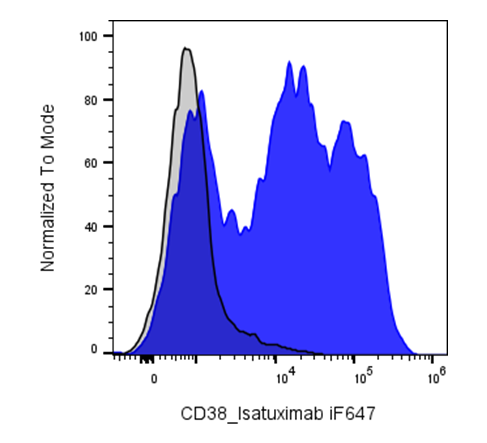
| Cat # | Size | Price | Quantity | |
|---|---|---|---|---|
| 116901 | 25 tests | $120 | ||
| 116902 | 100 tests | $275 |
| Clone | Isatuximab |
|---|---|
| Application | Flow Cytometry |
| Reactivity | Human |
| Format | iF647 |
| Target Name | CD38, gp45, Cyclic ADP-ribose hydrolase 1,T10, ADP-ribosyl cyclase |
| Isotype | Human IgG1 |
| Antibody Type | Monoclonal |
| Regulatory Status | RUO |
| Formulation | Phosphate-buffered solution, pH 7.2, containing 0.09% sodium azide and 0.2% (w/v) BSA |
| Protein Concentration | Supplied at a lot-specific concentration. |
| Storage&Handling | The antibody solution should be stored undiluted between 2°C and 8°C, and protected from prolonged exposure to light. Do not freeze. |
| Recommended Usage | For flow cytometric staining, it is recommended to use 5 µL of this reagent per 0.5-1.0 million cells in a 100 µL volume. Optimal reagent performance should be determined by titration for each specific application. iF647 has an excitation max at 656 nm and an emission max at 670 nm. |
| Excitation Laser | Red Laser (633 nm) |
| Research Areas | Cancer Marker, T cells, B cells, NK cells, Monocytes, Macrophages, Plasma cells |
| See All Formats | Clone Isatuximab |
Human CD38 is a multifunctional cell surface glycoprotein widely expressed on hematopoietic cells, particularly plasma cells, activated T and B lymphocytes, and some myeloid cells. It functions both as an ectoenzyme and a receptor, playing roles in cell adhesion, signal transduction, and calcium signaling. Enzymatically, CD38 catalyzes the conversion of NAD⁺ into cyclic ADP-ribose and other metabolites that regulate intracellular calcium mobilization, influencing cell activation and survival.
Structurally, CD38 is a type II transmembrane protein with a short cytoplasmic N-terminus, a single transmembrane domain, and a large extracellular catalytic domain containing the active site. Unlike classical ligand-receptor systems, CD38 interacts with molecules such as CD31 (PECAM-1) and utilizes NAD⁺ as a substrate for its enzymatic activity. These interactions contribute to immune cell communication and migration.
CD38 is highly expressed in multiple myeloma and certain leukemias, making it an important diagnostic marker and therapeutic target. It also plays roles in immune regulation and metabolic pathways, and its dysregulation has been linked to cancer progression and immune dysfunction. Isatuximab is a humanized monoclonal antibody targeting CD38 that binds a specific epitope on its extracellular domain. It induces tumor cell death through multiple mechanisms, including antibody-dependent cellular cytotoxicity (ADCC), complement-dependent cytotoxicity (CDC), and direct apoptosis. Clinically, isatuximab is approved for the treatment of multiple myeloma, often in combination with other agents, providing a targeted approach to eliminate CD38-expressing malignant plasma cells.
iF647 Human IgG1 Isotype Control Antibody
iF647 Anti-Human CD38 Antibody TDS
Have a product or application question? Consult our FAQs or contact us.