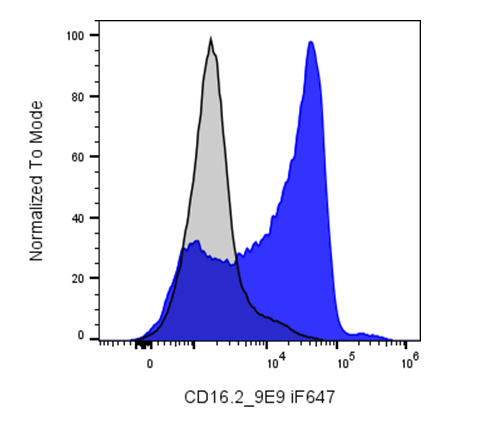
| Cat # | Size | Price | Quantity | |
|---|---|---|---|---|
| 205203 | 25 tests | $80 | ||
| 205204 | 100 tests | $160 |
| Clone | 9E9 |
|---|---|
| Application | Flow Cytometry |
| Reactivity | Mouse |
| Format | iF647 |
| Target Name | CD16.2, Fc gamma RIV, FcgRIV, Fcgr4, FcgammaRIV |
| Isotype | Armenian Hamster IgG |
| Antibody Type | Monoclonal |
| Regulatory Status | RUO |
| Formulation | Phosphate-buffered solution, pH 7.2, containing 0.09% sodium azide and 0.2% (w/v) BSA |
| Protein Concentration | Supplied at a lot-specific concentration. |
| Storage&Handling | The antibody solution should be stored undiluted between 2°C and 8°C, and protected from prolonged exposure to light. Do not freeze. |
| Recommended Usage | For flow cytometric staining, it is recommended to use 5 µL of this reagent per 0.5-1.0 million cells in a 100 µL volume. Optimal reagent performance should be determined by titration for each specific application. iF647 has an excitation max at 656 nm and an emission max at 670 nm. |
| Excitation Laser | Red Laser (633 nm) |
| Research Areas | Monocytes, Macrophages, Neutrophils, ADCC, Infectious Diseases, Inflammation |
| See All Formats | Clone 9E9 |
Mouse CD16.2 (FcγRIV) is a low-affinity activating Fc gamma receptor expressed on myeloid immune cells, including monocytes, macrophages, neutrophils, and certain dendritic cell subsets. It belongs to the immunoglobulin superfamily and mediates effector functions triggered by IgG immune complexes.
It is a type I transmembrane glycoprotein with an extracellular Ig-like domain responsible for binding IgG, a single-pass transmembrane region, and a short cytoplasmic tail. Unlike inhibitory Fcγ receptors, CD16.2 signals through association with the common Fc receptor gamma chain, which contains immunoreceptor tyrosine-based activation motifs (ITAMs) that initiate downstream signaling.
CD16.2 primarily binds IgG2a and IgG2b immune complexes in mice, promoting antibody-dependent cellular cytotoxicity, phagocytosis, and cytokine release. It plays a central role in host defense against pathogens but can also contribute to inflammatory and autoimmune pathology when overactivated.
In therapeutic contexts, CD16.2 is important for monoclonal antibody efficacy in preclinical mouse models, as its engagement enhances ADCC and tumor clearance. Conversely, blocking or modulating FcγRIV signaling is being explored to reduce autoimmune disease severity and excessive inflammation.
Overall CD16.2 serves as a key activating Fc receptor that bridges humoral immunity and cellular effector responses. Its balanced signaling determines whether IgG complexes drive protective immunity or pathological inflammation. Because of its strong role in antibody effector functions, it is widely used in mouse models to evaluate therapeutic antibodies and engineer improved Fc designs for enhanced clinical performance in vivo studies.
iF647 Armenian Hamster IgG Isotype Control Antibody
iF647 Anti-Mouse CD16.2 (FcγRIV) Antibody TDS
Have a product or application question? Consult our FAQs or contact us.