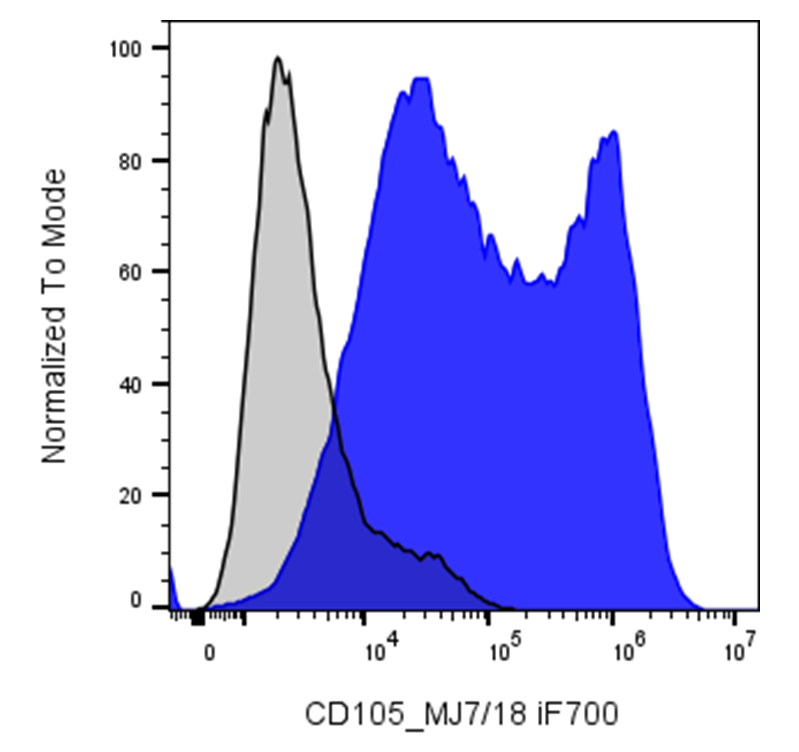
| Cat # | Size | Price | Quantity | |
|---|---|---|---|---|
| 208803 | 25 µg | $95 | ||
| 208804 | 100 µg | $220 |
| Clone | MJ7/18 |
|---|---|
| Application | Flow Cytometry |
| Reactivity | Mouse |
| Format | iF700 |
| Target Name | CD105, CD-105, CD 105, Endoglin |
| Isotype | Rat IgG2a, κ |
| Antibody Type | Monoclonal |
| Regulatory Status | RUO |
| Formulation | Phosphate-buffered solution, pH 7.2, containing 0.09% sodium azide and 0.2% (w/v) BSA |
| Protein Concentration | 0.2 mg/mL |
| Storage & Handling | The antibody solution should be stored undiluted between 2°C and 8°C, and protected from prolonged exposure to light. Do not freeze. |
| Recommended Usage | For flow cytometric staining, it is recommended to use less than 0.5 µg of this reagent per 0.5-1.0 million cells in a 100 µL volume. Optimal reagent performance should be determined by titration for each specific application. iF700 has an excitation max at 690 nm and an emission max at 710 nm. |
| Excitation Laser | Red Laser (633 nm) |
| See All Formats | Clone MJ7/18 |
CD105, also known as endoglin, is a transmembrane glycoprotein that functions as an accessory co-receptor in transforming growth factor-beta (TGF-β) superfamily signaling. It is highly expressed on proliferating vascular endothelial cells and is commonly used as a marker of active angiogenesis. CD105 helps regulate endothelial-cell proliferation, migration, vascular remodeling, and blood-vessel formation. It is also expressed by certain mesenchymal stromal cells, activated monocytes, and other cell populations, although expression levels vary by tissue and physiological condition.
Structurally, CD105 is a type I transmembrane protein that forms a disulfide-linked homodimer. Each subunit contains a large extracellular domain, a single transmembrane segment, and a short cytoplasmic tail. The extracellular region includes an orphan domain and a zona pellucida-like domain involved in protein interactions and dimerization. CD105 does not function as a conventional signaling receptor on its own; instead, it associates with type I and type II receptors of the TGF-β superfamily. Its principal interacting ligands are TGF-β1 and TGF-β3, and it can also participate in signaling involving bone morphogenetic proteins (BMPs), including BMP9 and BMP10, particularly in endothelial cells. These interactions help fine-tune signaling pathways that maintain vascular integrity and regulate angiogenesis.
CD105 has important implications in disease. Abnormal endoglin function is associated with hereditary hemorrhagic telangiectasia type 1, a genetic vascular disorder characterized by fragile blood vessels and arteriovenous malformations. CD105 is also frequently elevated in tumor-associated vasculature, where it supports angiogenesis and may contribute to tumor growth and progression. Because of its enrichment on actively proliferating endothelial cells, CD105 is widely investigated as a biomarker of tumor vascularization and disease prognosis.
Therapeutically, CD105 is a potential target for anti-angiogenic cancer strategies. Antibodies and other agents designed to inhibit CD105-mediated pathways may restrict tumor blood-vessel formation and complement existing cancer treatments. CD105 is also being explored as a target for imaging tumor vasculature and delivering therapeutic agents selectively to endothelial cells. However, because CD105 contributes to normal vascular homeostasis, therapeutic approaches must carefully balance antitumor activity with potential effects on healthy blood vessels.
iF700 Rat IgG2a Isotype Control
iF700 Anti-mouse CD105 Antibody TDS
Have a product or application question? Consult our FAQs or contact us.