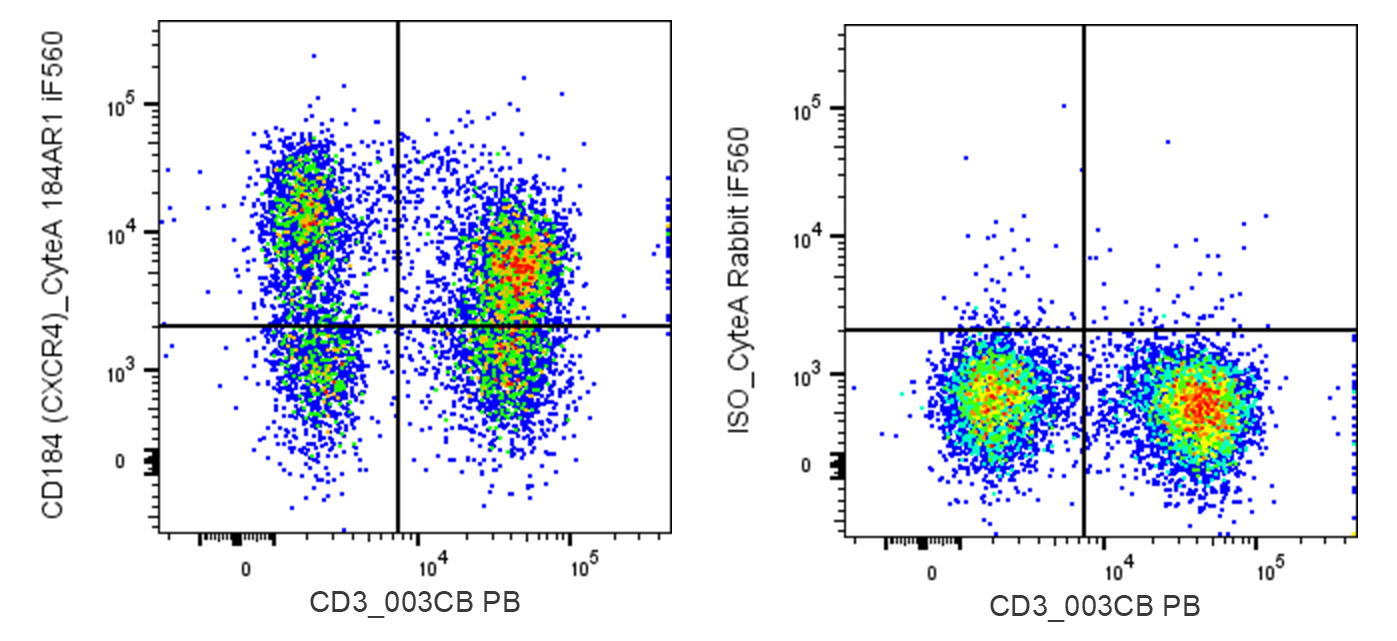
| Cat # | Size | Price | Quantity | |
|---|---|---|---|---|
| 180901 | 25 tests | $125 | ||
| 180902 | 100 tests | $250 |
| Clone | 184CB |
|---|---|
| Application | Flow Cytometry |
| Reactivity | Human |
| Format | iF560 |
| Target Name | CD184, CXCR4 |
| Isotype | Rabbit IgG |
| Antibody Type | Monoclonal |
| Regulatory Status | RUO |
| Formulation | Phosphate-buffered solution, pH 7.2, containing 0.09% sodium azide and 0.2% (w/v) BSA |
| Protein Concentration | Supplied at a lot-specific concentration. |
| Storage & Handling | The antibody solution should be stored undiluted between 2°C and 8°C, and protected from prolonged exposure to light. Do not freeze. |
| Recommended Usage | For flow cytometric staining, it is recommended to use 5 µL of this reagent per 0.5-1.0 million cells in a 100 µL volume. Optimal reagent performance should be determined by titration for each specific application. iF560 has an excitation max at 560 nm and an emission max at 571 nm. |
| Excitation Laser | Green/Yellow laser (532/561nm) |
| Brand | InnoSite |
| See All Formats | Clone 184CB |
Human CD184, also known as CXCR4 (C-X-C chemokine receptor type 4), is a chemokine receptor expressed on a wide variety of cell types, including hematopoietic stem cells, lymphocytes, monocytes, endothelial cells, and many epithelial tissues. CD184 plays a key role in regulating cell migration, immune surveillance, and tissue organization. It is particularly important in guiding the movement and homing of hematopoietic stem and progenitor cells to the bone marrow, as well as directing immune cells to sites of inflammation or injury.
Structurally, CD184 is a member of the G protein–coupled receptor (GPCR) family. It is composed of approximately 352 amino acids and contains seven transmembrane α-helical domains, an extracellular N-terminus involved in ligand binding, and an intracellular C-terminal tail that mediates signaling through heterotrimeric G proteins. Upon ligand binding, CD184 activates intracellular signaling pathways that regulate cell migration, survival, and proliferation.
The principal ligand for CD184 is the chemokine CXCL12, also known as stromal cell–derived factor-1 (SDF-1). The CXCL12–CXCR4 axis is essential for embryonic development, particularly in the formation of the cardiovascular, hematopoietic, and nervous systems. This signaling pathway also regulates leukocyte trafficking and stem cell retention within bone marrow niches.
CD184 is implicated in several diseases. It serves as a major co-receptor for the entry of HIV-1 into target cells and is also involved in cancer progression by promoting tumor cell migration and metastasis. Because of its biological importance, CD184 is an important therapeutic target. Small-molecule antagonists such as plerixafor are used clinically to mobilize hematopoietic stem cells for transplantation, and other CXCR4 inhibitors are being investigated for cancer treatment, antiviral therapy, and inflammatory diseases.
InnoSite™ iF560 Rabbit IgG, κ2 Isotype Control
InnoSite™ iF560 Anti-Human CD184 (CXCR4) Antibody TDS
Have a product or application question? Consult our FAQs or contact us.