| Cat # | Size | Price | Quantity | |
|---|---|---|---|---|
| 815601 | 25 ug | $145 | ||
| 815602 | 100 ug | $295 |
| Application | ELISA, BLI |
|---|---|
| Format | Liquid, Purified |
| Expression Host | CHO |
| Target Name | CD200, MOX1, MOX2, MRC, OX-2, My033 |
| Species | Mouse |
| Sources | Recombinant Mouse CD200 (Gln31-Gly232) with C-terminus His-Avi-tag is expressed in CHO cell. |
| Accession Number | O54901 |
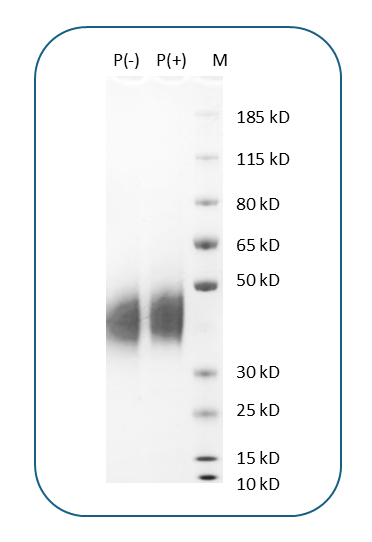
| Molecular Weight | The protein has a predicted molecular weight of 26.1 kDa. Under DTT-reducing conditions, it migrates at approximately 45 kDa on SDS-PAGE. |
| Affinity Tag | C-His-Avi |
| Purity | >95% based on SDS-PAGE under reducing condition |
| Regulatory Status | RUO |
| Formulation | 1xPBS buffer, pH7.4, 0.22 µm filtered |
| Endotoxin level | Not tested |
| Protein Concentration | 25µg size is bottled at 0.2mg/mL concentration. 100 µg size is supplied at a lot-specific concentration. |
| Storage and Handling | Briefly centrifuge the vial upon receipt. An unopened vial can be stored at 4°C for up to 2 weeks, or at -20°C or below for up to six months. The protein may be further diluted to 0.1 mg/mL using 0.22 µm-filtered PBS buffer (pH 7.4). For long-term storage, the diluted stock solution should be aliquoted and stored at ≤ –70°C to minimize freeze-thaw cycles. If additional dilution is required, carrier proteins such as FBS or BSA should be added to maintain protein stability. |
| Research Areas | B cells, Neurons, vacular endothelial cells, Cancer Marker, Immune Homeostasis |
CD200, also known as OX-2, is an immunoregulatory cell surface glycoprotein that plays a key role in maintaining immune tolerance and limiting inflammatory responses. It is broadly expressed on a variety of cell types, including thymocytes, B cells, activated T cells, dendritic cells, endothelial cells, neurons, and certain tumor cells. CD200 functions primarily by delivering inhibitory signals to myeloid lineage cells, thereby suppressing excessive immune activation and protecting tissues from immune-mediated damage.
Structurally, CD200 is a type I transmembrane protein belonging to the immunoglobulin superfamily. It consists of two extracellular immunoglobulin-like domains (one variable-like and one constant-like), a single transmembrane helix, and a short cytoplasmic tail that lacks known signaling motifs. Unlike many immune receptors, CD200 does not signal intracellularly through its own cytoplasmic domain. Instead, its biological effects are mediated through engagement of its receptor, CD200R, which is expressed predominantly on macrophages, monocytes, dendritic cells, mast cells, and some T cell subsets.
The primary ligand for CD200 is CD200R (CD200 receptor), an inhibitory receptor containing cytoplasmic signaling motifs that recruit adaptor proteins and downstream inhibitory pathways. Binding of CD200 to CD200R suppresses pro-inflammatory cytokine production, reduces antigen presentation capacity, and promotes an anti-inflammatory or tolerogenic phenotype in myeloid cells. This interaction is particularly important in immune-privileged sites such as the central nervous system, where CD200 expression on neurons helps restrain microglial activation.
Dysregulation of CD200 signaling has been implicated in several diseases. Overexpression of CD200 is observed in various malignancies, including chronic lymphocytic leukemia (CLL), multiple myeloma, and certain solid tumors, where it contributes to immune evasion by suppressing antitumor immunity. Conversely, insufficient CD200 signaling may exacerbate autoimmune or inflammatory conditions due to unchecked myeloid activation.
Therapeutically, CD200 is being explored as a target in oncology and immune modulation. Blocking antibodies against CD200 aim to restore antitumor immune responses by relieving myeloid suppression. In contrast, agonistic strategies enhancing CD200–CD200R signaling are being investigated for inflammatory and autoimmune diseases. By modulating innate immune checkpoints, CD200 represents a promising target for rebalancing immune responses in diverse clinical settings.
Mouse CD200 (OX-2) Protein (C-His-Avi) TDS
Human CD200 (OX-2) Protein (C-His-Avi)
Biotin Human CD200 (OX-2) Protein (C-His-Avi)
Human CD200 (OX-2) Protein (C-His)
PE Human CD200 (OX-2) Protein (C-His)
APC Human CD200 (OX-2) Protein (C-His)
Human CD200 (OX-2) Protein (C-Fc-Avi)
Biotin Human CD200 (OX-2) Protein (C-Fc-Avi)
Human CD200 (OX-2) Protein (C-Fc)
PE Human CD200 (OX-2) Protein (C-Fc)
APC Human CD200 (OX-2) Protein (C-Fc)
Have a product or application question? Consult our FAQs or contact us.