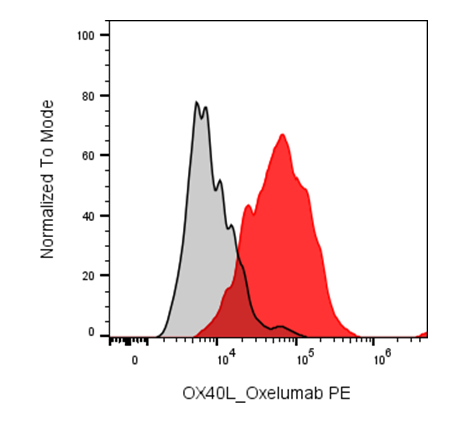
| Cat # | Size | Price | Quantity | |
|---|---|---|---|---|
| 115301 | 25 tests | $120 | ||
| 115302 | 100 tests | $275 |
| Clone | Oxelumab |
|---|---|
| Application | Flow Cytometry |
| Reactivity | Human |
| Format | PE |
| Target Name | CD252, OX40L, Gp34, CD134L, TNFSF4 |
| Isotype | Human IgG1 |
| Antibody Type | Monoclonal |
| Regulatory Status | RUO |
| Formulation | Phosphate-buffered solution, pH 7.2, containing 0.09% sodium azide and 0.2% (w/v) BSA |
| Protein Concentration | Supplied at a lot-specific concentration. |
| Storage&Handling | The antibody solution should be stored undiluted between 2°C and 8°C, and protected from prolonged exposure to light. Do not freeze. |
| Recommended Usage | For flow cytometric staining, it is recommended to use 5 µL of this reagent per 0.5-1.0 million cells in a 100 µL volume. Optimal reagent performance should be determined by titration for each specific application. PE has an excitation max at 565 nm and an emission max at 575 nm. |
| Excitation Laser | Blue Laser (488 nm) Green/Yellow laser (532/561nm) |
| Research Areas | Co-stimulation, Dendritic cells, B cells, Macrophages, T cell survival, Th1 cells, Th2 cells, Autoimmunity |
| See All Formats | Clone Oxelumab |
Human OX40L (CD252) is a member of the tumor necrosis factor (TNF) ligand superfamily and serves as a key costimulatory molecule in adaptive immunity. It is primarily expressed on activated antigen-presenting cells, including dendritic cells, B cells, and macrophages. OX40L binds to its receptor OX40 (CD134) on activated T cells, promoting T-cell proliferation, survival, and cytokine production. Structurally, OX40L is a type II transmembrane protein with a short cytoplasmic N-terminus, a transmembrane domain, and an extracellular TNF homology domain that mediates trimerization and receptor binding.
The primary ligand interaction of OX40L is with OX40, forming a bidirectional signaling axis that enhances T-cell responses and supports the development of memory T cells. Dysregulation of the OX40–OX40L pathway is implicated in autoimmune diseases, chronic inflammation, and allergic disorders, where excessive T-cell activation contributes to pathology. Conversely, this pathway is also important in anti-tumor immunity by sustaining effector T-cell function.
Oxelumab is a humanized monoclonal antibody targeting OX40L. By binding to OX40L, oxelumab blocks its interaction with OX40, thereby inhibiting downstream T-cell activation. This mechanism makes it particularly relevant for treating inflammatory and allergic diseases such as asthma. Therapeutically, oxelumab aims to dampen overactive immune responses, although its clinical development has shown mixed outcomes. Modulation of the OX40–OX40L axis remains an important strategy in both immunosuppressive and immunostimulatory therapeutic contexts.
PE Human IgG1 Isotype Control Antibody
PE Anti-human CD252 (OX40L) Antibody TDS
Have a product or application question? Consult our FAQs or contact us.