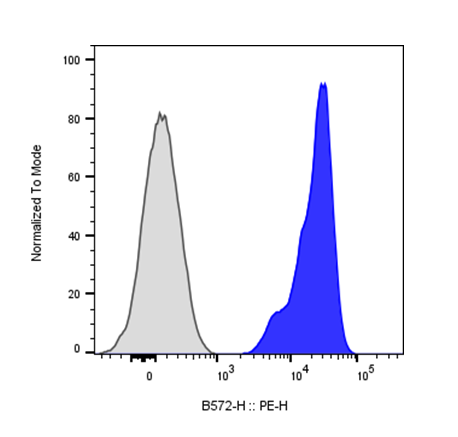
| Cat # | Size | Price | Quantity | |
|---|---|---|---|---|
| 109109 | 25 tests | $110 | ||
| 109110 | 100 tests | $250 |
| Clone | LNH-94 |
|---|---|
| Application | Flow Cytometry |
| Reactivity | Human |
| Format | PE |
| Target Name | CD298, ATPB-3, Na, K-ATPase beta-3 polypeptide |
| Isotype | Mouse IgG1 |
| Antibody Type | Monoclonal |
| Regulatory Status | RUO |
| Formulation | Phosphate-buffered solution, pH 7.2, containing 0.09% sodium azide and 0.2% (w/v) BSA |
| Protein Concentration | Supplied at a lot-specific concentration. |
| Storage&Handling | The antibody solution should be stored undiluted between 2°C and 8°C, and protected from prolonged exposure to light. Do not freeze. |
| Recommended Usage | For flow cytometric staining, it is recommended to use 5 uL of this reagent per 0.5-1.0 million cells in a 100 µL volume. Optimal reagent performance should be determined by titration for each specific application. PE has an excitation max at 565 nm and an emission max at 575 nm. |
| Excitation Laser | Blue Laser (488 nm) Green/Yellow laser (532/561nm) |
| Research Areas | Osmoregulation |
| See All Formats | Clone LNH-94 |
CD298, also known as the sodium/potassium-transporting ATPase subunit beta-3 or ATP1B3, is a 42 kDa type II transmembrane glycoprotein encoded by the ATP1B3 gene in humans. It is part of the Naâº/Kâº-ATPase enzyme complex, which consists of a catalytic α subunit and a regulatory β subunit. CD298 belongs to the family of Naâº/K⺠and Hâº/K⺠ATPase beta chain proteins and specifically to the Naâº/Kâº-ATPase subfamily. This integral plasma membrane protein is essential for establishing and maintaining the electrochemical gradients of sodium and potassium ions across the cell membrane—gradients that are crucial for osmoregulation, sodium-coupled transport of various molecules, and the electrical excitability of nerve and muscle cells. The β3 subunit plays a regulatory role by assisting in the proper assembly and membrane localization of the α/β heterodimer complex. CD298 is broadly expressed across various tissues, including all leukocyte populations.
PE Mouse IgG1 Isotype Control Antibody
Have a product or application question? Consult our FAQs or contact us.