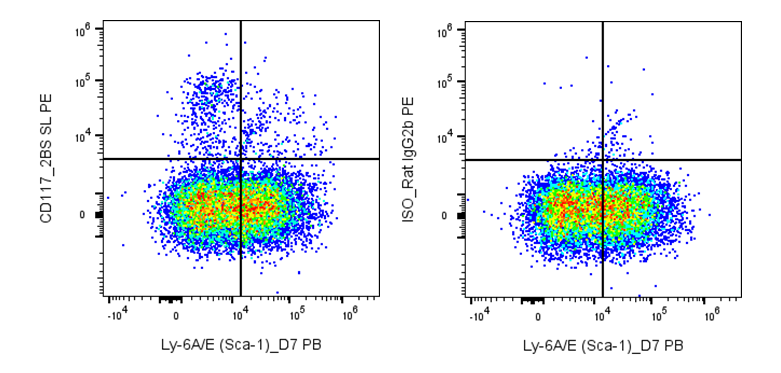
| Cat # | Size | Price | Quantity | |
|---|---|---|---|---|
| 204109 | 50 μg | $80 | ||
| 204110 | 200 μg | $220 |
| Clone | 2B8 |
|---|---|
| Application | Flow Cytometry |
| Reactivity | Mouse |
| Format | PE |
| Target Name | CD117, CD-117, c-Kit, Stem Cell Factor Receptor (SCFR) |
| Isotype | Rat IgG2b |
| Antibody Type | Monoclonal |
| Regulatory Status | RUO |
| Formulation | Phosphate-buffered solution, pH 7.2, containing 0.09% sodium azide and 0.2% (w/v) BSA |
| Protein Concentration | 0.2 mg/mL |
| Storage & Handling | The antibody solution should be stored undiluted between 2°C and 8°C, and protected from prolonged exposure to light. Do not freeze. |
| Recommended Usage | For flow cytometric staining, it is recommended to use less than 0.12 μg of this reagent per 0.5-1.0 million cells in a 100 μL volume. Optimal reagent performance should be determined by titration for each specific application. PE has an excitation max at 565 nm and an emission max at 575 nm. |
| Excitation Laser | Red Laser (633 nm) |
| See All Formats | Clone 2B8 |
Mouse CD117, also known as c-Kit, is a receptor tyrosine kinase that plays a critical role in the regulation of hematopoiesis, stem cell maintenance, and the development of several specialized cell types. CD117 is encoded by the Kit gene and is expressed on hematopoietic stem and progenitor cells, mast cells, melanocytes, germ cells, and certain progenitors in multiple tissues. In the immune system, CD117 is particularly well known as a marker of mast cells and early hematopoietic stem cells, where it regulates cell survival, proliferation, and differentiation.
Structurally, CD117 is a transmembrane glycoprotein belonging to the type III receptor tyrosine kinase family, which also includes receptors such as FLT3 and PDGFR. The receptor consists of an extracellular domain containing five immunoglobulin-like domains responsible for ligand binding, a single transmembrane region, and a cytoplasmic domain with intrinsic tyrosine kinase activity. Upon ligand binding, CD117 undergoes receptor dimerization, which triggers autophosphorylation of specific tyrosine residues within the intracellular domain. These phosphorylated sites then recruit signaling molecules that activate downstream pathways, including the PI3K–AKT, MAPK, and JAK/STAT signaling cascades.
The primary ligand for CD117 is stem cell factor (SCF), also known as Kit ligand or steel factor. SCF exists in both membrane-bound and soluble forms and is produced by stromal cells in the bone marrow and other tissues. Binding of SCF to CD117 promotes survival and expansion of hematopoietic stem cells, supports mast cell development, and contributes to the migration and differentiation of various progenitor cell populations. Because of this central signaling pathway, the SCF–CD117 axis is essential for normal blood cell formation and tissue homeostasis.
CD117 is also implicated in several diseases. Gain-of-function mutations in the Kit gene can lead to constitutive activation of the receptor and uncontrolled cellular proliferation. In mice and humans, such mutations are associated with disorders including mastocytosis, gastrointestinal stromal tumors (GIST), and certain leukemias. Conversely, loss-of-function mutations in Kit can disrupt hematopoiesis, pigmentation, and fertility, reflecting the broad biological roles of CD117 signaling.
Because of its involvement in cancer and stem cell biology, CD117 has become an important therapeutic target. Small-molecule tyrosine kinase inhibitors that block CD117 signaling, such as imatinib, have shown significant clinical benefit in diseases driven by KIT activation, particularly GIST. In research and experimental therapy, antibodies against CD117 are also used to identify and isolate hematopoietic stem cells and to condition recipients for stem cell transplantation by selectively depleting stem cell niches. These strategies highlight the importance of CD117 as both a biological marker and a therapeutic target in hematology and oncology.
PE Anti-Mouse CD117 Antibody TDS
Have a product or application question? Consult our FAQs or contact us.