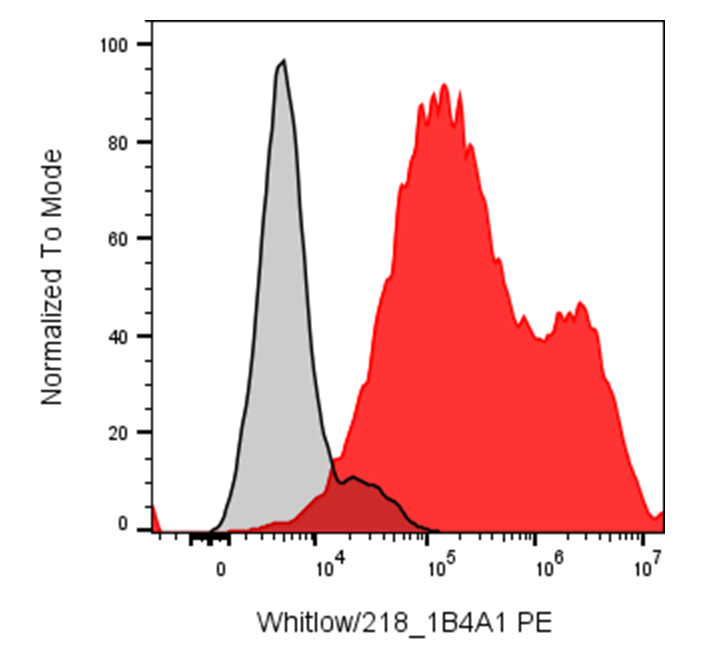
| Cat # | Size | Price | Quantity | |
|---|---|---|---|---|
| 360803 | 25 tests | $195 | ||
| 360804 | 100 tests | $460 |
| Clone | 1B4A1 |
|---|---|
| Application | Flow Cytometry |
| Reactivity | Whitlow/218 Linker |
| Format | PE |
| Target Name | Whitlow/218 linker, Whitlow 218 linker, CAR linker |
| Isotype | Rabbit IgG |
| Antibody Type | Monoclonal |
| Regulatory Status | RUO |
| Formulation | Phosphate-buffered solution, pH 7.2, containing 0.09% sodium azide and 0.2% (w/v) BSA |
| Protein Concentration | Supplied at a lot-specific concentration. |
| Storage & Handling | The antibody solution should be stored undiluted between 2°C and 8°C, and protected from prolonged exposure to light. Do not freeze. |
| Recommended Usage | For flow cytometric staining, it is recommended to use 5 μL of this reagent per 0.5-1.0 million cells in a 100 µL volume. Optimal reagent performance should be determined by titration for each specific application. |
| Excitation Laser | Blue Laser (488 nm) Green/Yellow laser (532/561nm) |
| Research Areas | CAR, CAR-T, Chimeric Antigen Receptor, Immunotherapy |
| See All Formats | Clone 1B4A1 |
Anti-Whitlow/218 Linker Antibody is an antibody designed to recognize the synthetic Whitlow/218 peptide sequence used as a linker between the variable heavy (VH) and variable light (VL) domains of single-chain variable fragments (scFvs). Because this linker is incorporated into many scFv-based chimeric antigen receptors (CARs), anti-Whitlow/218 antibodies provide a broadly applicable method for detecting CARs independently of their antigen specificity. The Whitlow/218 linker has been reported to improve resistance to proteolysis and aggregation within scFv structures.
Structurally, the Whitlow/218 linker is a flexible synthetic peptide; one commonly reported sequence is GSTSGSGKPGSGEGSTKG. It connects VH and VL domains and helps maintain the proper organization and flexibility of the CAR's extracellular antigen-binding domain. Anti-Whitlow/218 antibodies recognize epitopes within this linker sequence. Commercial monoclonal antibodies have been validated for flow cytometric detection of cell-surface CARs containing the linker.
The Whitlow/218 linker itself has no physiological ligand or receptor because it is an engineered sequence. Consequently, anti-Whitlow/218 antibodies do not have a conventional disease-associated target and are not themselves therapeutic agents. Their principal role is analytical, including detection and quantification of CAR-expressing cells by flow cytometry, immunofluorescence, and related assays. Recent studies demonstrated that anti-Whitlow/218 antibodies can detect CAR-T cells directed against different targets, including CD19 and BCMA.
In CAR-T therapy, anti-Whitlow/218 antibodies can support manufacturing quality control, characterization of engineered cells, and longitudinal monitoring of CAR-T-cell expansion and persistence. Because the antibody recognizes a common structural element rather than the CAR's target antigen, the same detection reagent can potentially be applied across multiple CAR designs containing the Whitlow/218 linker. This makes anti-Whitlow/218 antibodies useful research and clinical-monitoring tools for CAR-T-cell development and immune-cell therapy.
APC Rabbit IgG, κ2 Isotype Control (Fc silent) Antibody
PE Anti-Whitlow/218 Linker Antibody TDS
Have a product or application question? Consult our FAQs or contact us.