| Cat # | Size | Price | Quantity | |
|---|---|---|---|---|
| 808001 | 25 ug | $245 | ||
| 808002 | 100 ug | $595 |
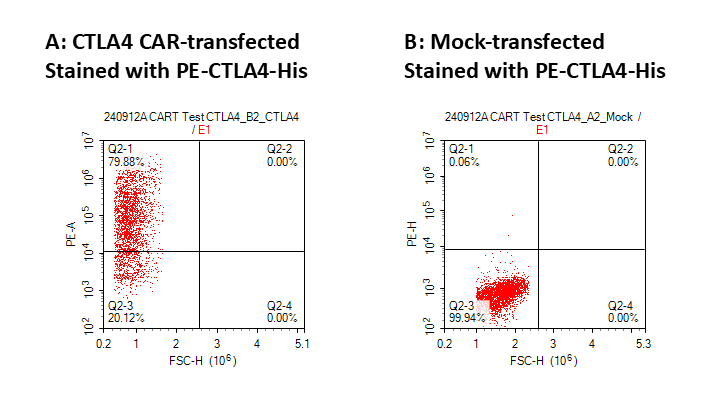
| Application | Flow Cytometry |
|---|---|
| Format | Liquid, PE |
| Expression Host | CHO |
| Target Name | CTLA4, CD152 |
| Species | Human |
| Sources | Recombinant Human CTLA4 Protein (Ala37-Phe162) with C-terminus His-tag is expressed in CHO cell and conjugated to PE. |
| Accession Number | P16410 |
| Molecular Weight | The protein has a predicted molecular weight of 15 kDa. Under DTT-reducing conditions, it migrates at approximately 25 kDa on SDS-PAGE prior to conjugation. |
| Affinity Tag | C-His |
| Regulatory Status | RUO |
| Formulation | 1xPBS buffer, pH7.4, 0.09% NaN3 with a carrier protein |
| Endotoxin level | Not tested |
| Protein Concentration | 25µg size is bottled at 0.1mg/mL concentration. 100 µg size is bottled at lot specific concentration. |
| Storage and Handling | Briefly centrifuge the vial upon receipt. An unopened vial may be stored at 2–8°C for up to six months. |
| Research Areas | Tregs, Activated T cells, Autoimmunity, Immune Checkpoints, Cancer Immunology |
Cytotoxic T-lymphocyte–associated protein 4 (CTLA-4), also known as CD152, is a critical immune checkpoint receptor that functions as a negative regulator of T cell activation. It is primarily expressed on activated CD4+ and CD8+ T cells and is constitutively expressed at high levels on regulatory T cells (Tregs). CTLA-4 plays a central role in maintaining immune homeostasis by limiting excessive T cell responses and promoting peripheral tolerance.
Structurally, CTLA-4 is a type I transmembrane glycoprotein and a member of the immunoglobulin superfamily. Its extracellular region consists of a single IgV-like domain responsible for ligand binding, followed by a transmembrane region and a short cytoplasmic tail. The cytoplasmic domain lacks intrinsic enzymatic activity but contains conserved signaling motifs, including a tyrosine-based motif that mediates interactions with intracellular signaling and trafficking proteins. CTLA-4 predominantly resides in intracellular vesicles and is rapidly transported to the cell surface following T cell activation.
The primary ligands for CTLA-4 are the B7 family co-stimulatory molecules CD80 (B7-1) and CD86 (B7-2), which are expressed on antigen-presenting cells such as dendritic cells, macrophages, and B cells. CTLA-4 binds CD80 and CD86 with significantly higher affinity and avidity than the activating receptor CD28. By outcompeting CD28 for ligand binding and actively removing CD80/CD86 from the surface of antigen-presenting cells through trans-endocytosis, CTLA-4 effectively dampens co-stimulatory signaling and restrains T cell activation.
Dysregulation of CTLA-4 function is associated with a range of diseases. Genetic deficiency or loss-of-function mutations in CTLA-4 can lead to severe lymphoproliferative disorders, autoimmunity, and immune dysregulation due to uncontrolled T cell activation. Conversely, excessive CTLA-4 activity can contribute to impaired immune responses, including reduced anti-tumor immunity. In cancer, tumor-induced upregulation of CTLA-4 signaling contributes to immune evasion by suppressing effective T cell responses.
CTLA-4 is a landmark target in immunotherapy. Therapeutic antibodies that block CTLA-4, such as immune checkpoint inhibitors, enhance T cell activation and proliferation by restoring co-stimulatory signaling, leading to improved anti-tumor immune responses in several cancers. However, CTLA-4 blockade can also disrupt immune tolerance, resulting in immune-related adverse events. Conversely, strategies that enhance CTLA-4 function or signaling are being explored for the treatment of autoimmune and inflammatory diseases. Together, these approaches highlight CTLA-4’s pivotal role at the intersection of immune regulation, disease, and therapy.
PE Human CTLA4 (CD152) Protein (C-His) TDS
Anti-Human CD80 (Galiximab Biosimilar), Clone Galiximab
Human B7-1 (CD80) Protein (C-His-Avi)
Biotin Human B7-1 (CD80) Protein (C-His-Avi)
Human B7-1 (CD80) Protein (C-His)
Anti-Human CTLA-4 (Ipilimumab Biosimilar), Clone Ipilimumab
In Vivo Star Anti-Mouse CD152 (CTLA-4) Antibody, Clone 9D9
CTLA-4 Fc Fusion Protein (Abatacept Biosimilar), Clone Abatacept
CTLA-4 Fc Fusion Protein (Belatacept Biosimilar), Clone Belatacep
Human CTLA4 (CD152) Protein (C-His-Avi)
Have a product or application question? Consult our FAQs or contact us.