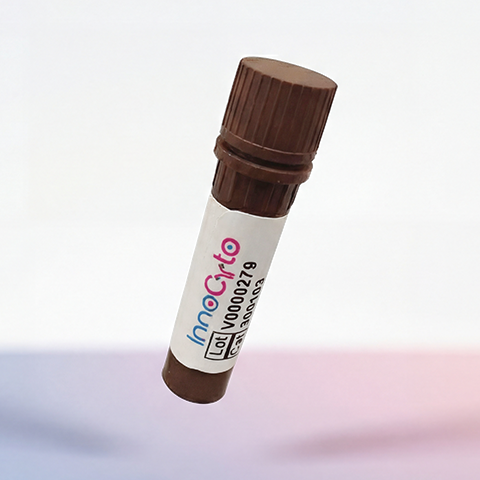
| Cat # | Size | Price | Quantity | |
|---|---|---|---|---|
| 811501 | 25 ug | $245 | ||
| 811502 | 100 ug | $595 |
| Application | Flow Cytometry |
|---|---|
| Format | Liquid, PE |
| Expression Host | CHO |
| Target Name | TNFRSF18, AITR, GITR, CD357 |
| Species | Human |
| Sources | Recombinant Human Human GITR/TNFRSF18 (Gln26-Glu161) with C-terminus His-tag is expressed in CHO cell and conjugated to PE. |
| Accession Number | Q9Y5U5 |
| Molecular Weight | The protein has a predicted molecular weight of 16.1 kDa. Under DTT-reducing conditions, it migrates at approximately 25 kDa on SDS-PAGE prior to conjugation. |
| Affinity Tag | C-His |
| Regulatory Status | RUO |
| Formulation | 1xPBS buffer, pH7.4, 0.09% NaN3 with a carrier protein |
| Endotoxin level | Not tested |
| Protein Concentration | 25µg size is bottled at 0.1mg/mL concentration. 100 µg size is bottled at lot specific concentration. |
| Storage and Handling | Briefly centrifuge the vial upon receipt. An unopened vial may be stored at 2–8°C for up to six months. |
| Research Areas | Co-stimulation, Tregs, Activated T cells, Cancer Immunology, Immune Checkpoints |
Glucocorticoid-induced tumor necrosis factor receptor–related protein (GITR), also known as CD357 or TNFRSF18, is a co-stimulatory receptor that plays an important role in regulating T cell activation, survival, and immune balance. GITR is constitutively expressed at high levels on regulatory T cells (Tregs) and at lower levels on naïve conventional T cells, with expression rapidly upregulated following T cell activation. It is also expressed on natural killer (NK) cells and some myeloid populations. Through its signaling, GITR influences both effector and regulatory arms of the immune system.
Structurally, GITR is a type I transmembrane glycoprotein and a member of the tumor necrosis factor receptor (TNFR) superfamily. Its extracellular region contains cysteine-rich domains typical of TNFR family members that mediate ligand binding. GITR has a single transmembrane segment and a cytoplasmic tail that lacks intrinsic enzymatic activity but recruits TNF receptor–associated factors (TRAFs), particularly TRAF2 and TRAF5. These adaptor proteins initiate downstream signaling cascades, including activation of NF-κB and MAPK pathways, which promote cell survival, proliferation, and cytokine production.
The primary ligand for GITR is GITR ligand (GITRL), also known as TNFSF18, which is expressed on activated antigen-presenting cells such as dendritic cells, macrophages, and B cells, as well as on endothelial cells in inflamed tissues. Engagement of GITR by GITRL provides a co-stimulatory signal that enhances effector T cell activation and resistance to suppression. In regulatory T cells, GITR signaling can transiently reduce suppressive function, thereby shifting the immune balance toward activation in certain contexts.
GITR has been implicated in a variety of disease settings. In autoimmune and inflammatory diseases, heightened GITR signaling may contribute to excessive T cell activation and tissue damage by weakening regulatory control. In allergic disease, GITR can promote Th2 responses and inflammation. In cancer, GITR is highly expressed on tumor-infiltrating Tregs, where it contributes to immune suppression within the tumor microenvironment. At the same time, GITR expression on effector T cells provides an opportunity to enhance anti-tumor immunity.
Therapeutically, GITR is an active target in immuno-oncology. Agonistic antibodies targeting GITR aim to simultaneously stimulate effector T cells and attenuate Treg-mediated suppression within tumors, thereby enhancing anti-tumor immune responses. These agents are being evaluated alone and in combination with immune checkpoint inhibitors. Conversely, strategies to inhibit GITR–GITRL interactions are being explored for the treatment of autoimmune and inflammatory diseases, highlighting GITR’s dual relevance as both a driver of immunity and a contributor to immune-mediated pathology.
PE Human GITR (TNFRSF18) Protein (C-His) TDS
Human GITRL/TNFSF18 Protein (N-His)
Human GITRL/TNFSF18 Protein (N-His-Avi)
Biotin Human GITRL/TNFSF18 Protein (N-His-Avi)
In Vivo Star Anti-Mouse CD357 (GITR) Antibody, Clone DTA-1-m2a
Human GITR (TNFRSF18) Protein (C-His-Avi)
Biotin Human GITR (TNFRSF18) Protein (C-His-Avi)
Human GITR (TNFRSF18) Protein (C-His)
Have a product or application question? Consult our FAQs or contact us.