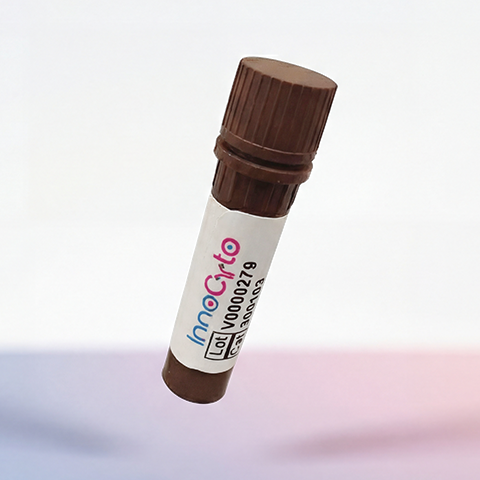
| Cat # | Size | Price | Quantity | |
|---|---|---|---|---|
| 820703 | 25 ug | $245 | ||
| 820704 | 100 ug | $595 |
| Application | Flow Cytometry |
|---|---|
| Format | Liquid, APC |
| Expression Host | CHO |
| Target Name | CD32b/c, FCGR2B, C, FcRII-b, c, CD32, FCG2, IGFR9 |
| Species | Human |
| Sources | Recombinant CD32b/c /Fc gamma RIIb (Ala46-Pro217) with C-terminus His-tag is expressed in CHO cell and conjugated to APC. |
| Accession Number | P31994 |
| Molecular Weight | The protein has a predicted molecular weight of 20.9 kDa. Under DTT-reducing conditions, it migrates at approximately 35 kDa on SDS-PAGE prior to conjugation. |
| Affinity Tag | C-His |
| Regulatory Status | RUO |
| Formulation | 1xPBS buffer, pH7.4, 0.09% NaN3 with a carrier protein |
| Endotoxin level | Not tested |
| Protein Concentration | 25µg size is bottled at 0.1mg/mL concentration. 100 µg size is bottled at lot specific concentration. |
| Storage and Handling | Briefly centrifuge the vial upon receipt. An unopened vial may be stored at 2–8°C for up to six months. |
| Research Areas | B cells, Plasma Cells, Monocytes, Macrophages, Platelets, Mast cells, Neutrophils, Autoimmunity, Infectious Diseases |
CD32B (FCGR2B) and CD32C (FCGR2C) are 40 kDa, type I transmembrane proteins belonging to the Ig superfamily of low-affinity IgG Fc receptors. CD32B contains an immunoreceptor tyrosine-based inhibition motif (ITIM) in its cytoplasmic tail, while CD32C has an immunoreceptor tyrosine-based activation motif (ITAM). Both receptors can bind monomeric IgG and IgG complexes, and are expressed on B cells, monocytes, macrophages, granulocytes, platelets, and mast cells. CD32B primarily acts as a negative regulator, inhibiting immune cell activation, proliferation, endocytosis, phagocytosis, and degranulation. In contrast, CD32C has an activating function, contributing to immune responses. Together, they play crucial roles in regulating immune cell functions and maintaining immune homeostasis. CD32B and CD32C share almost identical extracellular domain. The aa sequence of Fc gamma RIIB and Fc gamma RIIC are the same for the region expressed (Ala46-Pro217)
APC Human CD32b/c (FcγRIIB) Protein (C-His) TDS
Human CD32b/c (FcγRIIB) Protein (C-His-Avi)
Biotin Human CD32b/c (FcγRIIB) Protein (C-His-Avi)
Human CD32b/c (FcγRIIB) Protein (C-His)
PE Human CD32b/c (FcγRIIB) Protein (C-His)
Have a product or application question? Consult our FAQs or contact us.