| Cat # | Size | Price | Quantity | |
|---|---|---|---|---|
| 808703 | 25 ug | $245 | ||
| 808704 | 100 ug | $595 |
| Application | ELISA, BLI |
|---|---|
| Format | Liquid, Biotinylated |
| Expression Host | CHO |
| Target Name | TNFRSF9, 4-1BB, CD137 |
| Species | Human |
| Sources | Recombinant Human CD137/4-1BB Protein (Leu24-Gln186) with C-terminus Fc-Avi-tag is expressed in CHO cell. This protein was site-specifically labeled with Biotin by BirA ligase. |
| Accession Number | Q07011 |
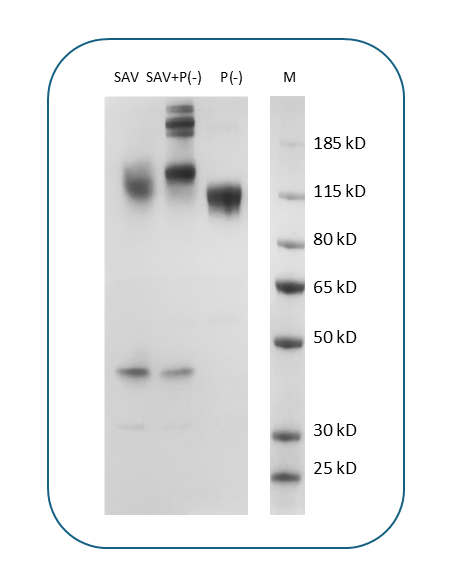
| Molecular Weight | The protein has a predicted molecular weight of 45.6 kDa. Under DTT-reducing conditions, it migrates at approximately 55-60 kDa on SDS-PAGE. |
| Affinity Tag | C-Fc-Avi |
| Purity | >95% based on SDS-PAGE under reducing condition |
| Regulatory Status | RUO |
| Formulation | 1xPBS buffer, pH7.4, 0.22 µm filtered |
| Endotoxin level | Not tested |
| Protein Concentration | 25µg size is bottled at 0.2mg/mL concentration. 100 µg size is supplied at a lot-specific concentration. |
| Storage and Handling | Briefly centrifuge the vial upon receipt. An unopened vial can be stored at 4°C for up to 2 weeks, or at -20°C or below for up to six months. The protein may be further diluted to 0.1 mg/mL using 0.22 µm-filtered PBS buffer (pH 7.4). For long-term storage, the diluted stock solution should be aliquoted and stored at ≤ –70°C to minimize freeze-thaw cycles. If additional dilution is required, carrier proteins such as FBS or BSA should be added to maintain protein stability. |
| Recommended Usage | For detection, use a secondary reagent with this product. |
| Research Areas | Activated T cells, Activated NK cells, Activated Endothelial cells, Cancer Immunology, Autoimmunity, Inflammation, Co-stimulation |
CD137, also known as 4-1BB or TNFRSF9, is a potent co-stimulatory receptor that plays an important role in regulating immune activation, particularly within T cells and natural killer (NK) cells. CD137 is not expressed on resting naïve T cells but is rapidly induced following antigen receptor engagement. It is expressed on activated CD8+ and CD4+ T cells, NK cells, dendritic cells, and other immune populations. Through its signaling, CD137 enhances immune cell expansion, survival, and effector function.
Structurally, CD137 is a type I transmembrane glycoprotein and a member of the tumor necrosis factor receptor (TNFR) superfamily. Its extracellular domain contains multiple cysteine-rich motifs characteristic of TNFR family members that mediate ligand binding. CD137 has a single transmembrane region and a cytoplasmic tail that lacks intrinsic enzymatic activity but recruits TNF receptor–associated factors (TRAFs), particularly TRAF1 and TRAF2. These adaptor proteins activate downstream signaling pathways such as NF-κB, MAPK, and PI3K–AKT, promoting cell survival and metabolic fitness.
The primary ligand for CD137 is CD137 ligand (CD137L, also known as 4-1BBL or TNFSF9), which is expressed on activated antigen-presenting cells including dendritic cells, macrophages, and B cells, as well as on some non-hematopoietic cells in inflamed tissues. Engagement of CD137 by its ligand delivers a strong co-stimulatory signal that enhances T cell proliferation, increases production of effector cytokines such as interferon-γ, and supports the development of long-lived memory T cells. In NK cells, CD137 signaling augments cytotoxic activity and antibody-dependent cellular cytotoxicity.
CD137 has been implicated in multiple disease contexts. In chronic inflammatory and autoimmune diseases, excessive CD137 signaling may contribute to tissue damage by sustaining pathogenic immune responses. In cancer, however, insufficient CD137-mediated co-stimulation can limit effective anti-tumor immunity. CD137 is often upregulated on tumor-infiltrating lymphocytes, reflecting recent activation and providing a potential target for immunomodulation. Expression of CD137 on endothelial cells within tumors has also been linked to immune cell trafficking.
Therapeutically, CD137 is a major target in cancer immunotherapy. Agonistic antibodies targeting CD137 aim to boost T cell and NK cell activity and enhance anti-tumor responses, either alone or in combination with other immunotherapies such as immune checkpoint inhibitors or tumor-targeting antibodies. While potent, CD137 agonists require careful dosing to avoid systemic toxicity. Beyond oncology, modulating CD137 signaling is also being explored in infectious and inflammatory disease models, underscoring its importance as a central regulator of immune activation.
Biotin Human CD137/4-1BB/TNFRSF9 Protein (C-Fc-Avi) TDS
Human 4-1BBL/TNFSF9 Protein (N-Fc)
Human 4-1BBL/TNFSF9 Protein (N-His)
Anti-Human CD137 (4-1BB) Antibody, Clone 4B4-1
iF647 Anti-Human CD137 (4-1BB) Antibody, Clone 4B4-1
In Vivo Star Anti-Mouse CD137 (4-1BB) Antibody, Clone 3H3
Human CD137/4-1BB/TNFRSF9 Protein (C-His-Avi)
Biotin Human CD137/4-1BB/TNFRSF9 Protein (C-His-Avi)
Human CD137/4-1BB/TNFRSF9 Protein (C-His)
Have a product or application question? Consult our FAQs or contact us.