| Cat # | Size | Price | Quantity | |
|---|---|---|---|---|
| 802001 | 25 ug | $145 | ||
| 802002 | 100 ug | $295 |
| Application | ELISA, BLI |
|---|---|
| Format | Liquid, Purified |
| Expression Host | CHO |
| Target Name | GPC3, GTR2-2, MXR7, SDYS, OCI5, |
| Species | Human |
| Sources | Human Glypican-3 (Gln25-His559) with C-terminus His tag is expressed in CHO cells |
| Accession Number | P51654 |
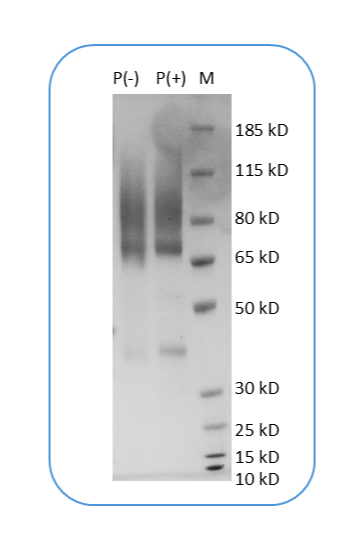
| Molecular Weight | The protein has a predicted molecular weight of 62kDa. Under DTT-reducing conditions, it migrates at approximately 65-100 kDa on SDS-PAGE. |
| Affinity Tag | C-His |
| Purity | >95% based on SDS-PAGE under reducing condition |
| Regulatory Status | RUO |
| Formulation | 1xPBS buffer, pH7.4, 0.22 µm filtered |
| Endotoxin level | Not tested |
| Protein Concentration | 25µg size is bottled at 0.2mg/mL concentration. 100 µg size is supplied at a lot-specific concentration. |
| Storage and Handling | Briefly centrifuge the vial upon receipt. An unopened vial can be stored at 4°C for up to 2 weeks, or at -20°C or below for up to six months. The protein may be further diluted to 0.1 mg/mL using 0.22 µm-filtered PBS buffer (pH 7.4). For long-term storage, the diluted stock solution should be aliquoted and stored at ≤ –70°C to minimize freeze-thaw cycles. If additional dilution is required, carrier proteins such as FBS or BSA should be added to maintain protein stability. |
| Research Areas | Development, Embryogenesis, Cancer Marker |
Glypicans are heparan sulfate proteoglycans anchored to the cell surface by a glycosyl-phosphatidylinositol (GPI) linkage. There are six known mammalian glypicans (GPC1 to GPC6), which can be released by the lipase Notum. They regulate signaling pathways like Wnt, Hedgehog, FGF, and BMPs. Glypican-3 (GPC3) plays a role in modulating IGF2 interactions and influences cell proliferation. It also interacts with FGF-basic via heparan sulfate chains. Mutations in GPC3 cause Simpson-Golabi-Behmel Syndrome (SGBS), leading to overgrowth, dysmorphism, and malformations. GPC3 is expressed as a 70 kDa precursor, cleaved into a 40 kDa N-terminal and 30 kDa C-terminal subunit. It is highly expressed in Hepatocellular carcinoma and melanoma, but downregulated in cancers like ovarian, cholangiocarcinoma, mesothelioma, and breast cancer due to promoter hypermethylation.
Human Glypican-3 Protein (C-His) TDS
Biotin Human Glypican-3 Protein (C-His)
PE Human Glypican-3 Protein (C-His)
APC Human Glypican-3 Protein (C-His)
Have a product or application question? Consult our FAQs or contact us.