| Cat # | Size | Price | Quantity | |
|---|---|---|---|---|
| 117101 | 25 tests | $120 | ||
| 117102 | 100 tests | $260 |
| Clone | Ivuxolimab |
|---|---|
| Application | Flow Cytometry |
| Reactivity | Human |
| Format | iF647 |
| Target Name | CD134, OX40, TNFRSF4 |
| Isotype | Human IgG2 |
| Antibody Type | Monoclonal |
| Regulatory Status | RUO |
| Formulation | Phosphate-buffered solution, pH 7.2, containing 0.09% sodium azide and 0.2% (w/v) BSA |
| Protein Concentration | Supplied at a lot-specific concentration. |
| Storage&Handling | The antibody solution should be stored undiluted between 2°C and 8°C, and protected from prolonged exposure to light. Do not freeze. |
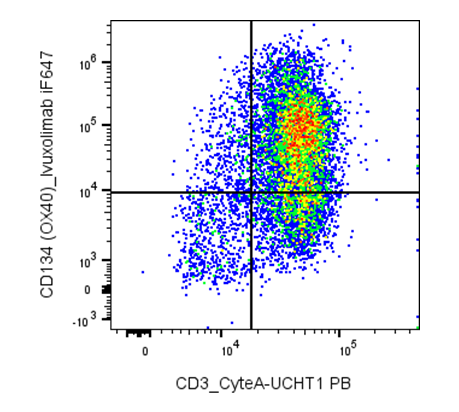
| Recommended Usage | For flow cytometric staining, it is recommended to use 5 µL of this reagent per 0.5-1.0 million cells in a 100 µL volume. Optimal reagent performance should be determined by titration for each specific application. iF647 has an excitation max at 656 nm and an emission max at 670 nm. |
| Excitation Laser | Red Laser (633 nm) |
| Research Areas | Co-stimulation, Activated T cells, Tregs, Activated NK cells, Neutrophils, Activated Dendritic cells, Autoimmunity |
| See All Formats | Clone Ivuxolimab |
Human CD134, also known as OX40 or TNFRSF4, is a co-stimulatory immune checkpoint receptor expressed primarily on activated CD4+ and CD8+ T cells, as well as subsets of regulatory T cells. It belongs to the tumor necrosis factor receptor superfamily and is upregulated after T-cell receptor engagement. Structurally, CD134 is a type I transmembrane glycoprotein containing multiple extracellular cysteine-rich domains, a single transmembrane region, and a cytoplasmic tail that recruits TRAF adaptor proteins to initiate downstream NF-κB and MAPK signaling pathways that promote T-cell survival and proliferation.
CD134 binds its cognate ligand CD252 (OX40L), which is expressed on antigen-presenting cells such as dendritic cells, B cells, and activated endothelial cells. Ligand engagement stabilizes T-cell activation, enhances effector cytokine production, and supports memory T-cell formation. In disease, OX40 signaling contributes to chronic inflammation and autoimmunity when dysregulated, but is also essential for effective anti-viral and anti-tumor immune responses. Overexpression of OX40/OX40L axis activity has been observed in several cancers, where it can paradoxically reflect ongoing immune activation yet insufficient tumor clearance.
Ivuxolimab is an investigational monoclonal antibody targeting human CD134 (OX40). It is designed to activate OX40 signaling, enhancing effector T-cell responses and anti-tumor immunity while modulating regulatory T-cell suppression in tumors. Clinically, OX40 agonism is studied in cancer immunotherapy, often combined with PD-1 or PD-L1 inhibitors to improve durable immune responses in clinical research settings and translational studies ongoing.
iF647 Human IgG2 Isotype Control
iF647 Anti-Human CD134 (OX40) Antibody TDS
Have a product or application question? Consult our FAQs or contact us.